Interview with Equitable Life’s tax and estate planning consultant: Bryan McNulty
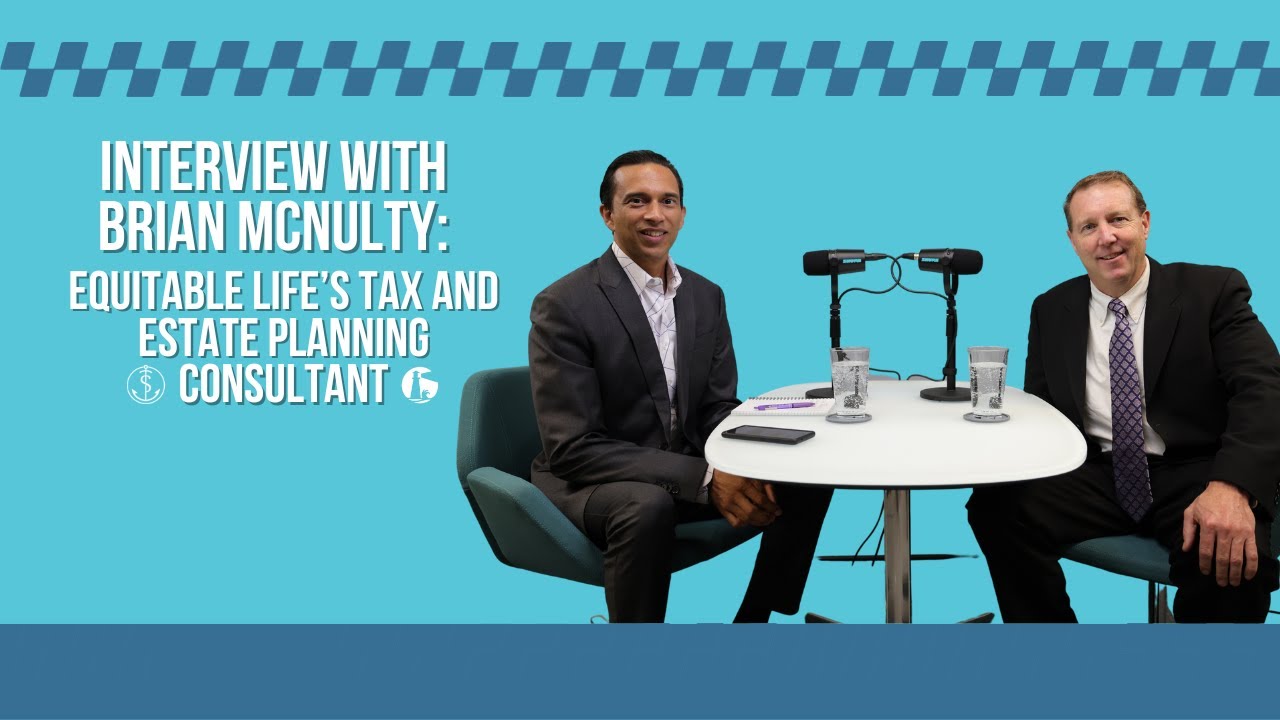
We had the wonderful opportunity to interview Equitable Life’s tax and estate planning consultant, Bryan McNulty. Bryan is on the national estate and tax planning team at Equitable and was previously with another large Canadian insurance company. Below we have transcribed portions of the interview in a question-and-answer format to allow you to read some of the highlights from the interview with Bryan.
We recommend for the unabridged conversation to watch the video below as well.

Trusts in Canada
Laurent: We're getting a lot of inquiries right now from Canadians who probably are watching a lot of American financial education online, whether that's YouTube or TikTok or Instagrams or any of the other social channels.
They've got a lot of questions about setting up trusts because this seems to be a big topic for American money-maker, entrepreneur, investor, category of people. But I know that trusts and the way that they operate in Canada are much different. Maybe can you talk about some pros and cons of setting up a life insurance policy inside a trust in Canada and how it might be different than what they're seeing online?
Bryan: Let me just start with the US. The US has different rules, and a lot of times trusts are created to avoid US estate tax at death. Sometimes trusts are used just for privacy because trust doesn't get probated, so no one can see the will and see where things go in it. And that can be used in a Canadian context.
In Canada, I think we tend to use trusts more to own specific assets, sometimes for protection reasons, both from who it's intended to benefit or from creditors. Occasionally, we will have a lot of insurance policies, particularly on children in trusts, because you don't want a child getting access to these assets when they're 18 and you have that trust, it can go on for quite an amount of time and also can protect it from future spouses and future creditors. I see it in that context. I don't see too many people setting up a trust to own a policy for themselves.
Laurent: What types of people should do that?
Bryan: If it's a significant amount of assets, a trust makes a lot of sense because it can manage the asset and it just creates an extra layer of protection and privacy. I would say you need quite a bit of assets because there's a cost of creating the trust and there's a cost of filing tax returns for the trust.
It's not necessarily a tax savings vehicle in the sense that it basically is tax at the highest marginal tax bracket. There's no tax savings having it there. Again, it depends on the situation, depends on the client. Now, the other context where we see trust is if someone has a business, they might have shares of that business owned by the trust. That's more of a tax planning vehicle to hold assets for a future generation.
The growing popularity of of permanent life insurance in Canada
Laurent: We've seen a huge uptick in the popularity of permanent insurance for Canadians, especially in the business owner category, way more than I've seen before since doing this for 12 years. Are you guys seeing something similar at Equitable? Why are people coming to you? And where do you see this giant surge in popularity coming from?
Bryan: It's interesting because it has really picked up in the last probably 15 years. You can see by the proliferation of companies that are offering the insurance. And the main one in particular is participating whole life insurance. There are two types of permanent. There's whole life and then there is universal life.
The government made some rules in 2017 and in combination with low interest rates have made universal life not as popular because the pricing became a little higher. And so, as a result, the participating life insurance has really increased in popularity. And in fact, I think the last numbers I've is somewhere around 65% of all premium dollars is participating whole life. That being said, it's not the most policies that are sold. It's just the one where the most money is going into it.
Laurent: What types of people do you see taking these types of policies out and out?
Bryan: It's interesting because you are seeing a lot more people that traditionally weren't doing it before. It has traditionally been really popular with higher net worth individuals and individuals who own businesses where they have a life insurance need, that they need it for when they pass away. It might be just funding taxes. It may be creating a safe state for their family, a legacy, a charitable bequest, or it could just be to make sure a family business continues on and they don't have to sell assets or providing for a child who's not part of the business, but they want to leave some assets too, but not the business.
Growing interest in younger Canadians
Laurent: Right, we've seen a huge uptick just in our own business, especially younger people. I find that this traditionally was an older person's game. Then now, through magic of video education online, other people are finding out about this who maybe didn't have access before to the knowledge.
Bryan: You see a lot of new Canadians in participating whole life now. I think the post-pandemic start of a recession has played a role in people looking at more of a risk management asset, as opposed to probably in the early part of pandemic, everyone was in the stock market, the whole Robin hood and going along those lines. Now you're seeing a lot more people are going back to a bit more safety.
Laurent: Yeah, we definitely saw that in our business during the pandemic. People wanted to talk about making 10 times their money on some crypto coin versus a 6 % dividend inside an insurance policy. It was not super interesting, but now none of those crypto coins are doing anything. So suddenly, 6 % becomes very attractive.
Another bit that doesn't get talked about so much when markets are hot but gets talked about a lot when markets cool off is just the erosion of your savings and your investments due to taxes overtime. Could you talk about the tax status of life insurance in Canada and why it would be beneficial for wealth accumulation and estate maximization?
Bryan: From the very basic part of it, just the policy itself, it's a heavily regulated industry and there are policies where you can put investment component into it. The great part of that is that it's not annually taxed. It's basically got tax-exempt status. Now, there's limits to how much you can put into the policy for the investment component, otherwise, everyone would be putting every investment possible in it. But the growth tax-free does make a huge difference. With interest rates the way they are, people are receiving relatively good returns on interest-bearing instruments, but they're losing half of it to tax because interest income isn't favorably taxed. But if it's in a life insurance policy, there's no annual taxation to the policy hold.
Life insurance policies and how they relate to the CDA
Laurent: Could you talk about what happens when a life insurance policy pays to a corporation or a holding company, and especially how that relates to what's called a capital dividend account or CDA?
Bryan: We talked about just a regular policy, growing tax-free and on death you get the tax-free amount. If you have it in a company and you're using after tax business income to fund those premiums, the business income is taxed really low. Therefore, it doesn't cost a lot of after-tax dollars to pay the premiums. Then the policy grows tax-free. Then when the person dies, the corporation gets all of the insurance proceeds tax-free. But in addition to that, there's an account called the capital dividend account, and that's a notional account that it's like a tracking account. Basically, the insurance proceeds minus a calculation called the Adjusted Cost Basis of the Policy goes into that account and can be distributed out tax-free as capital dividends to shareholders who are residents in Canada.
Laurent: We've also recently had the new passive income rules put in place for Canadian business owners. You talked about how there were some changes in 2017. Maybe you can talk about how life insurance can play a part in helping business owners to grow their money inside the corporation and then how it's affected or not affected by the passive income rules?
Bryan: The passive income rules were generally the government's attempt to prevent private business owners from accumulating too many assets in their corporation. What they said is, if you have more than $50,000 of passive income, you lose what's called the small business deduction, where you start losing it. It's phased in over $100,000 of income over $50,000.
So small businesses get a low tax rate. Here in BC, it's 11% for their first $500,000 of business income, and then it jumps up to 27%. What the government says, if you have more than $50,000 of passive income, they're going to take back some of that small business deduction. Basically, by the time the income, passive income becomes 150,000, you'll lose an entire small business deduction.
So, from dollar one, the company would have to pay 27% on its business income now. That passive income is only passive taxable income. So, interest income, dividends, the taxable portion of a capital gain, go into that calculation. If some of that money is diverted into a life insurance policy, the growth in that policy is not part of that taxable income. It's a way to help prevent that from being eroded quicker than it otherwise would have.
More referrals from accountants?
Laurent: Are you guys seeing any sort of uptick in the referrals from accountants or lawyers who previously had a bunch of tax planning that they could do for corporate money that maybe went away when all those rules changed. Are you seeing different types of professions, looking at life insurance more now than they used to.
Bryan: We're seeing some, maybe not as much as we probably should, but I think what we have seen is accountants recommending money get bonused out as a salary as opposed to it, which then the individual gets taxed on the money and not the corporation. And that way the corporation isn't accumulating as much income in it, right, and not having as much passive income.
But you know, I think accounts have come a long way. I was at an accounting firm for several years, and you know, I find the accountants are really getting on board with a lot of permanent insurance, it used to be buy term insurance and investing the difference they're more now leaning towards the tax-exempt status and the benefit of the capital dividend account and looking more at buying corporate owned life insurance.
How clients have used their policy loans
Laurent: Switching gears a little bit, traditionally clients that were told about cash values inside a life insurance policy were usually positioned in a way that expresses this money's here in an emergency and you have access to it. We take a different approach and we're actively consulting our clients to use the cash values through leverage. Which would be either a policy loan or from a lender maybe like a CSV loan or an IFA loan or IRP loan. But can you give examples where you've seen recently of clients using the cash value to grow either their wealth or to reinvest in their business? Like any cool stories of somebody saying, “hey I'm taking a big policy loan to do this.”
Bryan: It depends on the circumstances, and I always say the leveraging is right for the right client. Not every client wants to, some clients just want that life insurance policy just to stay there and grow. But there's many clients who otherwise wouldn't get life insurance coverage that's needed by particularly business owners, they really need the insurance coverage. Something happens to them because they might be the only source of income in their family, or just might be a huge tax liability or something along those lines. But they also realize to grow the business you need capital. And by doing that, accessing the cash values either through a policy loan or a collateral loan from a third party institution is a way to get back the money that has been put in that policy and use it, but still not give up the life insurance policy because traditionally the only solution was to cash in the policy if. It wasn't the only solution. You know, policy loans have been around forever because people weren't utilizing them, they were cashing in the policies and then they lost their insurance coverage. So, this is an effective way. Now, if it's structured properly, they might have some tax deductions for the interest being paid, so you know, that can bring down the actual cost of financing the loan.
Thank you for reading the highlights from our interview with Equitable Life’s tax and estate planning consultant, Bryan McNulty.
We hope you enjoyed and are looking forward to sharing more interviews in the near future.



Contact Us
At Safe Pacific Financial, we specialize in helping Canadian business owners, incorporated professionals, and investors structure life insurance for maximum wealth protection, tax savings, and business growth.
If you would like to discuss whole life insurance or investments, we’re happy to chat and see if we can be a good fit to work with you. Fill out our contact form and we will get back to you within 24 hours on business days.
Related Insights

The Silent Risk in Your Portfolio
Executive Summary The silent risk is real estate concentration, where 60% to 80% of a successful Canadian's net worth sits in property that can't be...

Why High Income Isn't the Same as Financial Security
Executive Summary A high income is a resource, not a financial plan, and on its own it can hide real structural fragility behind lifestyle creep,...

Your Corporation Has Accounts You've Probably Never Seen
Executive Summary Your corporation tracks three notional accounts, the Capital Dividend Account, RDTOH, and GRIP, that never appear on a statement but directly determine how...

What Happens After You Reach Out to Safe Pacific?
Executive Summary When you reach out to Safe Pacific, a real person from our team emails you within 24 hours with a link to book...

The Protection Playbook for High-Income Employees
Here's something that surprises a lot of people. Some of the most financially fragile households we see are actually very high-income families. Not because they're...

Whole Life Insurance: The Strategy Most People Miss
Most investment portfolios are built around three pillars. You have equities, you have fixed income, and here in Canada, a lot of people have real...

Why High Earners Are More Vulnerable Than They Think
Most people assume that earning more money makes life simpler. More income, more security, more options. But the uncomfortable truth we see every day is...

How to Protect Your Income in Canada with Disability & Critical Illness Insurance
What would happen to your savings, your retirement plan, and your finances in general if you were sick or injured tomorrow and couldn't work? How...

The Decisions Your Future Self Will Thank You For
Most financial plans assume that life stays ordinary and orderly. Your income continues, the markets recover on schedule, your health holds up. But future you...

Liquidity: The Missing Piece that breaks most Financial Plans
Most financial plans look great on paper. Strong net worth, solid investments, a growing business. But here's an uncomfortable truth: a lot of plans don't...

Why Your Finances Feel Disorganized (Even When You're Doing Well)
Here's something we've been hearing a lot in client meetings recently, almost word for word: "I know I should have a better handle on all...

The Estate Tax Bill Most Business Owners Never See Coming
What actually arrives in the estate from a corporate investment portfolio versus a corporately owned life insurance policy. Every projection a business owner sees starts...