Here's something that surprises a lot of people. Some of the most financially fragile households we see are actually very high-income families. Not because they're doing anything wrong, and not because they're bad with money, but because their entire financial life depends on one thing: income, and continuing to earn that income. The mortgage, the private school, the investments, the lifestyle. When that income is several hundred thousand dollars a year, the stakes are high.
Most financial planning starts with investments. But for high-income families, the real foundation is something else entirely. It's your ability to keep earning that income. At Safe Pacific, we help high-income Canadians design strategies that focus not just on growth, but on stability. And in this guide we're going to walk through a real, anonymized case study of a family earning over $600,000 a year, and exactly how we structured their plan to protect the income that supports the entire thing.
The Family
Everything here has been anonymized and cleaned, with no personal identifying details, but the picture is real. The couple is married and in their early forties, with two kids, a ten-year-old boy and an eight-year-old girl. Both spouses work in senior executive roles in their respective industries and have built strong, stable careers. As a result, their household income is substantial: combined gross earnings sit right between $600,000 and $700,000 a year before tax. That puts them firmly in the top income bracket in Canada, with a large portion of their earnings taxed at the highest marginal rates. They pay a lot of tax every year.
On the balance sheet, they have a great foundation. Their assets include their primary residence, with the mortgage getting paid down over time, plus a rental property that generates income. They hold registered accounts, an RRSP and a TFSA, along with non-registered investment accounts. On paper, this is exactly what you want: high income, growing assets, and a long investment horizon.
But there's one structural constraint that significantly shapes their planning options. One of the spouses recently transitioned from traditional employment to working as a contractor. At first glance, that looks like it might open the door to corporate tax planning. In this situation, though, the CRA classifies the arrangement as a personal services business. That designation applies when a contractor effectively works for a single client and performs duties much like an employee would. When the CRA applies it, most of the typical advantages of operating through a corporation disappear. That spouse's income is treated largely the same as employment income, the corporate tax deferral strategies are off the table, the small business tax rate doesn't apply, and corporate investment approaches like retained-earnings planning or corporate wealth-multiplier structures aren't available. As a result, the majority of this household's income flows directly into personal income tax, where it's taxed very high.
The Tax Reality
At this income level, tax planning isn't a secondary consideration. It's the central force that shapes how much of their money they actually keep. This family lives in British Columbia, so we'll use BC numbers, but it's similar across the country, give or take a couple of points.
In BC, once your income passes roughly $250,000, every additional dollar you earn is taxed in the top marginal bracket, where the combined federal and provincial rate is around 53%. In practical terms, more than half of every dollar they earn over $250,000 is gone straight to tax. When you earn this kind of income personally, and you don't have the ability to do corporate planning, there are simply fewer structural tax tools available to you than a business owner has.
So the primary tax strategy available to most high-income employees is the traditional one: maximize the RRSP every year. And RRSPs are genuinely valuable here, for a few reasons. You get an immediate tax deduction in the year you contribute, which reduces your taxable income at your top marginal rate. You get tax-deferred growth inside the plan, so your money compounds without annual tax drag. And you build a long-term pool of retirement savings. When you're in the highest bracket, each dollar you put in reduces your tax at that highest rate, which makes RRSP contributions especially attractive in these peak earning years.
The RRSP Tax Trap
In the short term, that's great. But over time, maximizing your RRSP exposes you to a new planning challenge. When we project this family's plan forward, the long-term numbers become significant.
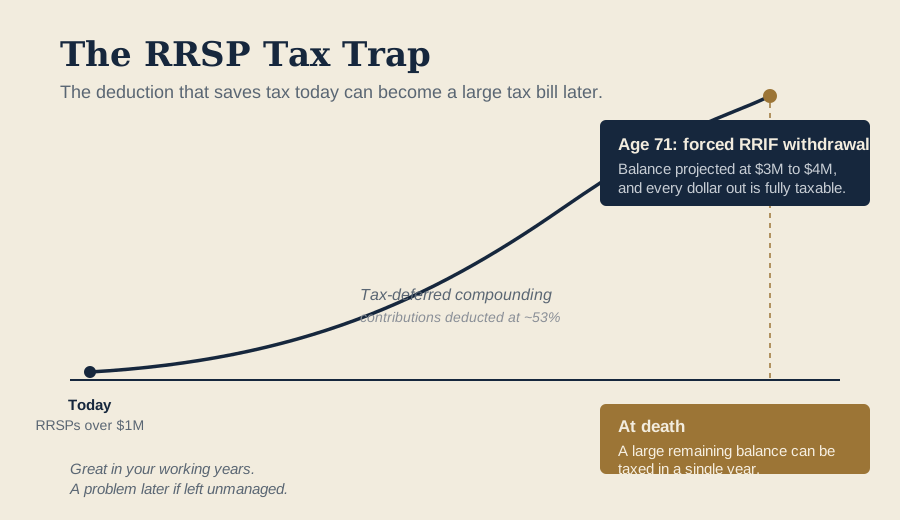
Today, their combined RRSP balances already exceed a million dollars. If they keep maximizing contributions every year and their investments grow at a reasonable rate, those accounts will expand dramatically through compounding. By the time they reach age 71, which is when an RRSP must convert to a RRIF and you're required to start drawing it down, we project their balances could reach $3 to $4 million.
That's where the second phase of the tax problem shows up. Once you hit 71, the withdrawals are mandatory whether you want the money or not, and they increase gradually each year on a government schedule. Everything you take out of a RRSP or RRIF is fully taxable as income. So the very thing that reduced their taxes during their working years can create a large taxable income stream later in life. If the RRIF gets big enough, those forced withdrawals are expensive, they can affect other retirement income, and they can keep you in high tax brackets even in retirement. And if both spouses were to pass away holding significant RRSP or RRIF balances, the entire amount could be fully taxable in the year of death. There was a widely shared story recently of a woman in Ontario whose parents passed away and left her with a roughly $600,000 tax bill she never saw coming, even though the family thought they'd done everything right. The CRA still wanted its money.
None of this means RRSPs are a mistake. RRSPs are great. But it does mean you can't just contribute the maximum and stop paying attention, especially as a high-income professional whose accounts can become very large, and especially when you have other income sources. This family has a rental property today, and they may well own several by the time they retire, which compounds the effect. Understanding how the RRSP interacts with your long-term tax planning, your estate plan, and your income protection plan is what keeps you from handing half of it back to Ottawa.
The Strategy: Protection First
Because the corporate tax strategies aren't available to them, this family's plan has to start from a different foundation. Instead of leading with tax deferral or complex investment structures, it begins with something far more fundamental: protect the income that supports the whole thing. If something goes wrong with their income, everything else falls apart.
For this family, covering all their bills and living the way they live runs between $17,000 and $20,000 a month. That level of spending includes the mortgage, the kids and their private school, ongoing contributions to their investments, a good quality of life, and a few trips a year. The stability of the entire plan depends on both spouses continuing to work and earn, because they need to produce roughly $20,000 a month no matter what.
When your household income is in the $600,000 to $700,000 range, that income becomes the single most valuable financial asset you have. Most people don't look at it that way. They think about the house they own, or the stocks, or a particular investment. But for a lot of people, the most important part of the financial plan is actually the money being brought into it in the first place, because that's what pays for everything else.
There are really only three things that can interrupt that income: you can die, you can become sick, or you can become injured. Any one of them would hit this family immediately and hard. That's why the first step we took wasn't about investments, and it wasn't about taxes. It was about protecting the income.
The Protection Stack
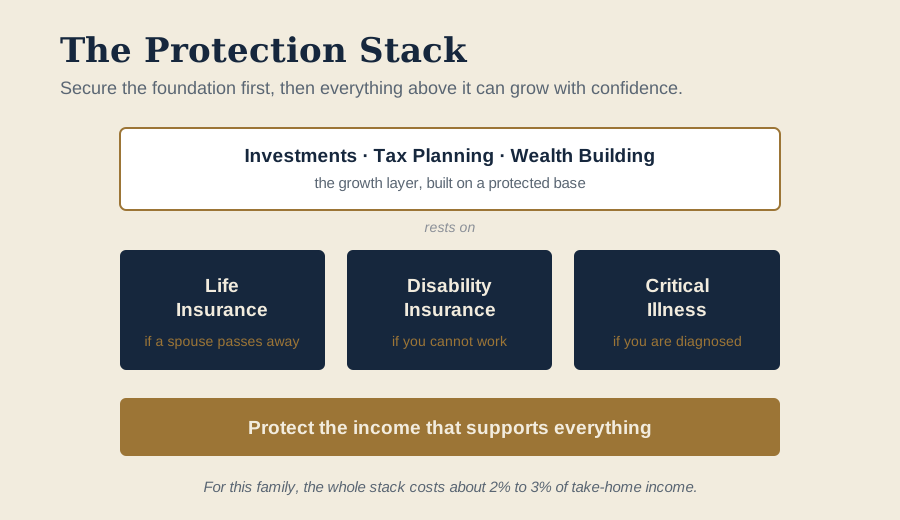
We addressed that risk with a layered framework built around three core insurance protections. Most of the clients we work with end up with a plan that looks something like this.
The first layer is life insurance, in this case term life insurance. It provides a tax-free death benefit if the husband or the wife passes away, and the coverage is structured to replace their income and pay off debts like the mortgage, so the surviving spouse and the children can maintain their current lifestyle. That means the kids can stay in the same school, keep playing the same sports, keep taking trips, and keep living the way they live now, just with one parent instead of two.
The second layer is disability income insurance, and this one is really important. It's probably the least talked about, but for high-income professionals, disability risk is arguably the most important to address, maybe even more than mortality risk. The odds of getting sick or injured are higher than the odds of dying, especially in your forties. For this couple we put together a fairly detailed disability plan with an own-occupation definition, which means the benefit pays if a spouse can't perform the specific duties of their own profession, even if they could technically go and do some other kind of job. That's the strongest form of the coverage, and we always try to secure the highest level a person's occupation allows.
The third layer is critical illness insurance, which pays a tax-free lump sum if one of the parents is diagnosed with a serious medical condition. Depending on the insurer, these policies cover somewhere between 22 and 26 conditions, but the bulk of payouts, around 80%, come from cancers, strokes, heart attacks, and coronary artery disease. The money can be used for anything. It gives you the time and the financial room to focus on treatment rather than rushing back to work, and it lets you pursue alternatives if you're not satisfied with what the provincial plan is directing you toward, including seeking care in another country if that's what you decide to do.
Together, these three coverages create what we call the protection stack. Life insurance if you pass away, disability insurance if you get sick or injured, and critical illness insurance if you're diagnosed with one of the major diseases so many Canadians end up facing. Each layer addresses a different category of financial risk, and together they form a comprehensive safety net designed to stabilize the household's finances during exactly the years when the income matters most, while the kids are eight and ten and nowhere near independent, and while corporate planning simply isn't an option.
Cost Discipline: The 3% That Protects the 97%
One of the most overlooked pieces of an effective plan is cost discipline. High-income households often assume that comprehensive protection must be very expensive. In reality, when the insurance is structured correctly, the cost of transferring this catastrophic risk to an insurer can be relatively small compared to the income it protects.
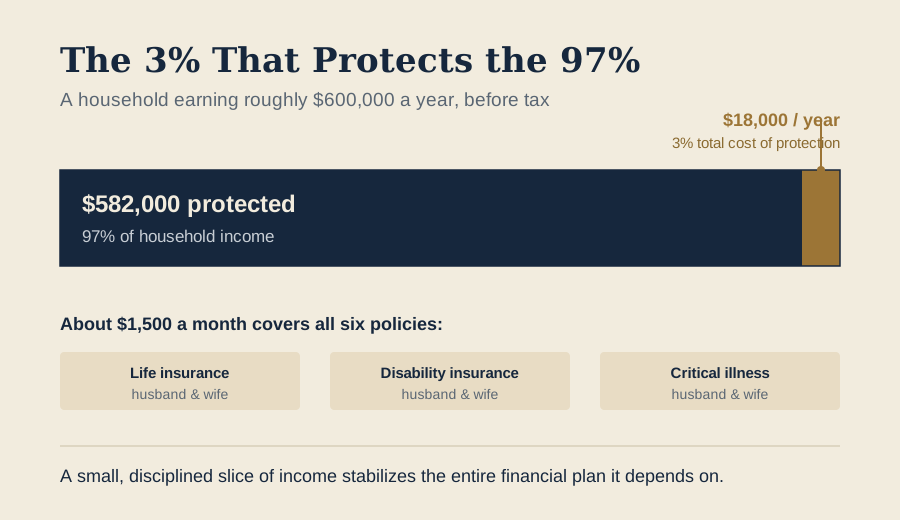
For this couple earning between $600,000 and $700,000 gross, the total cost of the entire protection stack, term life, disability, and critical illness coverage on both spouses, works out to roughly 2% to 3% of their take-home income. Call it about $18,000 a year, or around $1,500 a month, for all six policies combined. That $18,000 protects the other $582,000 of pre-tax income. That's the part that never gets talked about. A modest, disciplined allocation protects the entire financial structure that depends on their earning power.
This is central to how financial planning should work. Insurance isn't primarily about investment returns or wealth accumulation. Its job is to transfer risk to the insurance company. You pay them to take on the catastrophic risks, death, disability, and illness, so that a single event doesn't unravel the plan that supports everything else. Once those major risks are covered, the rest of the plan is free to do what it does best: long-term investing, tax-efficient saving, wealth accumulation, and retirement planning. Without protection in place, families often feel compelled to self-insure, which forces them to hold large emergency reserves, take less investment risk, or delay their goals. Designing the protection properly in the first place gives you the confidence that the foundation is secure, which frees you up to pursue growth everywhere else.
Building In Flexibility for the Future
A good financial plan doesn't just solve today's problems. It preserves flexibility for the decisions you'll face as your situation evolves. This family's picture is going to change. The kids won't always be eight and ten. The mortgage should shrink over time. The investment portfolio will grow. And eventually they'll want to retire, which is a significant change in itself.
As all of that happens, new priorities will emerge, and they'll start thinking about estate planning, about passing wealth to their kids in the most efficient way, about asset protection, and about creating tax-efficient liquidity at death to cover the many things that come due. Permanent insurance, the whole life insurance we often talk about, tends to be the tool for those long-term goals. But it isn't necessarily ideal for them today. Right now the priority is protecting the income during these high-earning years, and permanent coverage costs more than term.
So rather than committing to permanent insurance now, we set up their term policies with guaranteed conversion rights. Most term policies in Canada include this feature, as long as you're working with an insurer that also offers permanent insurance. Conversion rights let the policyholder convert some or all of the term coverage into permanent coverage at a later date, and crucially, they can do it without new medical underwriting. They complete the underwriting today, while they're young and healthy, and they don't have to requalify based on their health at conversion.
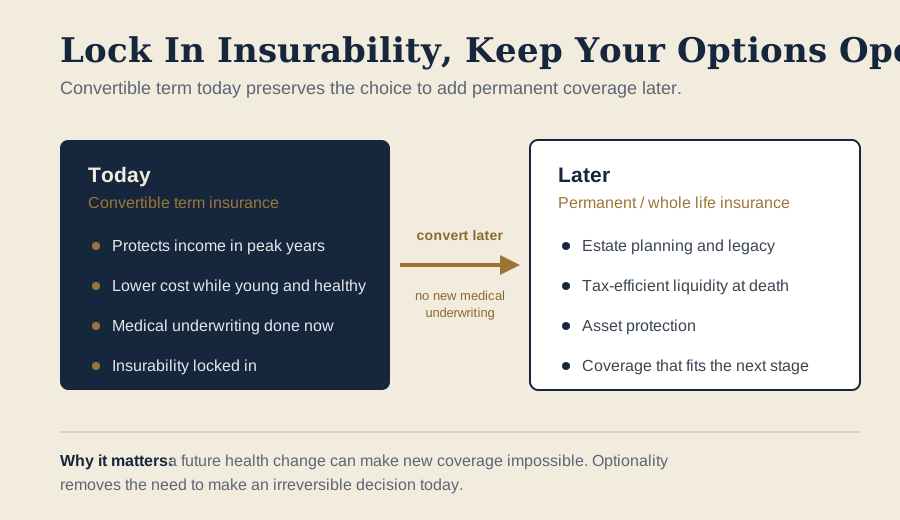
That matters enormously, because it lets you lock in your insurability today. A health change is unpredictable. Nobody knows they're going to be diagnosed with cancer at 46. Without guaranteed conversion rights, a future health issue could make it impossible to get new coverage at exactly the point when you need it most, as estate planning becomes central. There are rules around which years you can convert in, so this is something a good advisor should be tracking on your behalf. But structured properly, convertible term does two things at once: it gives you the protection you need now while you're working, and it gives you the ability to transition into permanent coverage later if it becomes advantageous for estate planning or tax efficiency. In financial planning, that kind of optionality is valuable precisely because it reduces the need to make irreversible decisions today.
The Takeaway
The big principle in this case study is simple. If you earn a high income, you don't need a corporation to build a strong, resilient financial plan. Most of the financial advice online is built either around the average Canadian earner or around corporate strategies for business owners, retained earnings, corporate-owned insurance, and the like. Those tools are powerful, but the corporate ones simply aren't available to some high-income professionals who can't or aren't allowed to incorporate. And there isn't much content made for people earning $600,000 or $700,000 a year, because that's the top 1% of Canadians, and it's a small audience to create for. That doesn't make the need any less real.
Not being able to incorporate doesn't mean you can't have a strategy. For this family, we took it back to the basics and focused on something foundational: protect the financial engine that supports the entire plan, which is the parents' ability to keep earning. The protection stack of term life, disability, and critical illness coverage secured the risks most likely to disrupt their financial life, at a cost of just 2% to 3% of income. That modest slice bought them stability, security for the kids, peace of mind, and long-term flexibility. Strong plans start at the foundation, with discipline, with taking risk off the table, and with long-term planning. When the foundation is secure, the rest of the strategy has the freedom to pursue growth, and you can take more risk in your investments precisely because you know the base is protected.
Every household is different. Different income, different income sources, different family structures, different existing investments, different tax exposure, and different existing RRSPs. That's why the first step is always a proper discovery and analysis.
If you're a high-income professional or an executive and you want to understand how a strategy like this could apply to your own situation, book here to schedule a no-pressure Discovery Call with one of our advisors. Nobody is going to try to sell you anything. We'll review your current structure, your income, the taxes you're paying, and any existing insurance, then run different scenarios to see where adjusting something improves the stability and efficiency of your plan, and whether you have any gaps or exposures you aren't aware of. If you'd prefer to keep learning first, join our newsletter where we regularly break down advanced planning strategies for high-income Canadians and business owners. You can also follow our YouTube here to keep up on new videos.



Book Your Consultation
Book a meeting with Safe Pacific today to design a strategy that fits your goals.

Right-Sizing: Why the Best Strategy Isn't Always the Biggest or the Smallest One
Executive Summary The right strategy is the one correctly sized to what you're actually trying to accomplish, which sometimes means less than what's on the...

The Corporate Asset Your Accountant Isn't Talking About
Executive Summary A properly structured corporate-owned participating whole life policy functions less like insurance and more like a tax-sheltered fixed-income allocation on your corporate balance...

If Something Happened to You Tomorrow… Would Your Plan Actually Work?
Executive Summary: Probably not the way you think, because most business owners have the components of a plan rather than a plan designed to function...
You’re Not Paying Too Much Tax — You Just Don’t Have a Strategy
Executive Summary The tax bill that frustrates incorporated Canadians usually isn't caused by the rates, it's caused by the absence of a coordinated strategy across...

The Silent Risk in Your Portfolio
Executive Summary The silent risk is real estate concentration, where 60% to 80% of a successful Canadian's net worth sits in property that can't be...

Why High Income Isn't the Same as Financial Security
Executive Summary A high income is a resource, not a financial plan, and on its own it can hide real structural fragility behind lifestyle creep,...

Your Corporation Has Accounts You've Probably Never Seen
Executive Summary Your corporation tracks three notional accounts, the Capital Dividend Account, RDTOH, and GRIP, that never appear on a statement but directly determine how...

What Happens After You Reach Out to Safe Pacific?
Executive Summary When you reach out to Safe Pacific, a real person from our team emails you within 24 hours with a link to book...
The Protection Playbook for High-Income Employees
Here's something that surprises a lot of people. Some of the most financially fragile households we see are actually very high-income families. Not because they're...

Whole Life Insurance: The Strategy Most People Miss
Most investment portfolios are built around three pillars. You have equities, you have fixed income, and here in Canada, a lot of people have real...

Why High Earners Are More Vulnerable Than They Think
Most people assume that earning more money makes life simpler. More income, more security, more options. But the uncomfortable truth we see every day is...

How to Protect Your Income in Canada with Disability & Critical Illness Insurance
What would happen to your savings, your retirement plan, and your finances in general if you were sick or injured tomorrow and couldn't work? How...