Executive Summary
A properly structured corporate-owned participating whole life policy functions less like insurance and more like a tax-sheltered fixed-income allocation on your corporate balance sheet, because its growth avoids annual passive income tax, doesn't count toward the AAII calculation that erodes your small business deduction, and eventually flows to your family tax-free through the Capital Dividend Account. Your accountant likely hasn't raised it not because they think it's a bad idea, but because introducing and designing it falls outside what they're engaged and compensated to do.
There's a tension inside almost every successful incorporated business in Canada. You're doing the right thing. You're growing the business, keeping the retained earnings inside the corporation, and investing that money so it compounds over time.
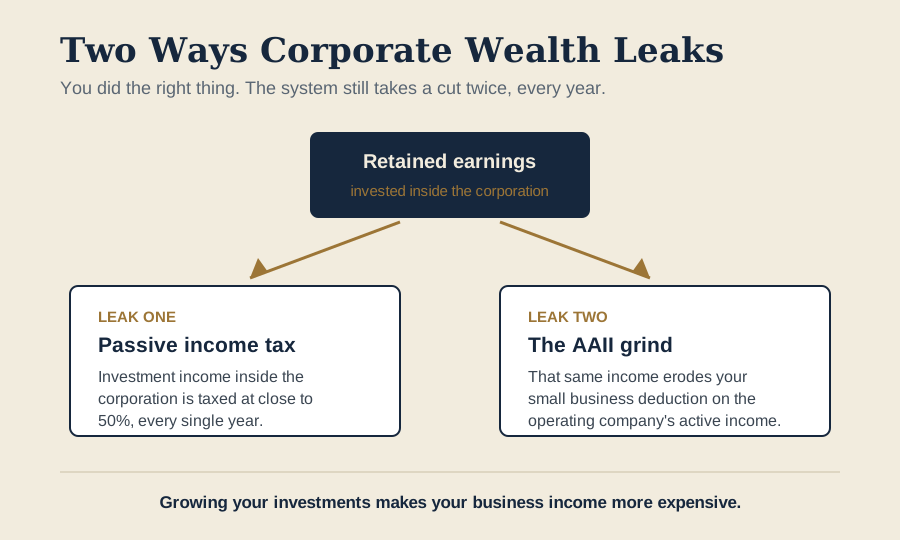
And every year, a meaningful chunk of that wealth is being siphoned off in two ways most owners haven't fully understood. First, the passive income tax on your corporate investments, which approaches 50%. Second, the passive income grind, the Adjusted Aggregate Investment Income rules, which quietly take away your small business deduction at the same time your investments are growing.
There's a structural fix that most accountants don't bring up. Not because they don't know about it, but because it isn't really their job to introduce it. At Safe Pacific, we want to walk through that tool the way it should be explained: not as an insurance pitch, but as a structural conversation about your corporate balance sheet.
The Problem: Two Leaks at Once
Here's what's actually happening inside a corporation that's doing well.
When your corporation earns active business income, it's taxed at the small business rate on the first $500,000 of net income, roughly 11% to 13% depending on the province. That's the favourable rate and one of the genuine advantages of being incorporated.
When you take that after-tax profit and invest it, the income those investments generate is passive income, and passive income is taxed at the highest corporate rate, often close to 50%. On money the corporation already paid tax on once. That's the tax drag, and it's how you fail to get ahead.
Then there's the second leak. Once your corporation's passive investment income exceeds $50,000 in a year, you begin losing access to the small business deduction at a five to one ratio. Every dollar of passive income above $50,000 costs you five dollars of small business deduction. By the time you're generating $150,000 of passive income, the small business rate is gone entirely on your operating company's active income. Depending on your province, that can mean an additional 15% or more in tax on the business itself.
Reframing What Participating Whole Life Actually Is
When most business owners think about life insurance, they think about cost. Something you pay for, a drag on the income statement, in exchange for protection if something bad happens. That's accurate for term insurance. Term is an expense: you pay premiums, you have coverage, the policy expires, and that's the end of it.
Participating whole life is a different animal, and the word "insurance" describes only a small part of how it works.
Strip away the label and look at the mechanics. A corporate-owned participating whole life policy is a tax-sheltered fixed-income allocation on your corporate balance sheet.
Here's what that means in plain terms. Inside a properly structured policy, your premium dollars go two places. Part pays for the actual insurance coverage. A larger part, when it's structured the way we do it, goes to cash accumulation, building what's called the cash surrender value. That cash value is invested by the insurer in a large professionally managed pool called the participating fund.
For most Canadian insurers offering this, that pool is weighted toward what you'd expect in a conservative institutional portfolio: investment-grade bonds, commercial mortgages, real estate, infrastructure, and in some cases some equity exposure. It's diversified and oriented around stability, closer to how a pension fund or a large endowment invests than to a growth portfolio.
The returns on that pool, minus costs, are credited back to policyholders as dividends. Structured the way we design them, those dividends purchase additional paid-up insurance, which increases the death benefit, which adds to the cash value, which generates the next dividend. It compounds.
The key part for our purposes: all of that growth, the cash value accumulation, the dividend reinvestment, the compounding, happens without triggering tax inside your corporation each year the way a traditional investment does. Compare that to a corporate investment account holding $100,000 in dividend-paying stocks, GICs earning interest, or bonds. Every dollar of that income gets taxed at corporate rates annually.
So the first shift is this. Stop thinking about participating whole life as insurance with some bonus features, and start thinking about it as a corporate asset that includes insurance protection as one of its features. The asset is the cash value, the long-term compounding, and the tax-deferred growth inside your corporation. The death benefit is real and important, but the reason this tool appears in sophisticated corporate plans is the asset behaviour.
Three Mechanics That Make It Work
The reframe is one thing. The mechanics are what determine whether this is actually useful in your situation.
One: EDO and paid-up additions.
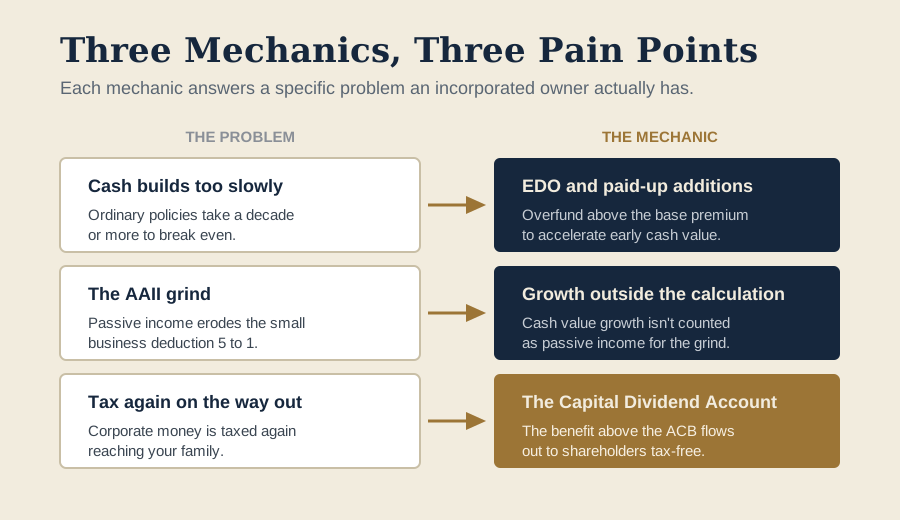
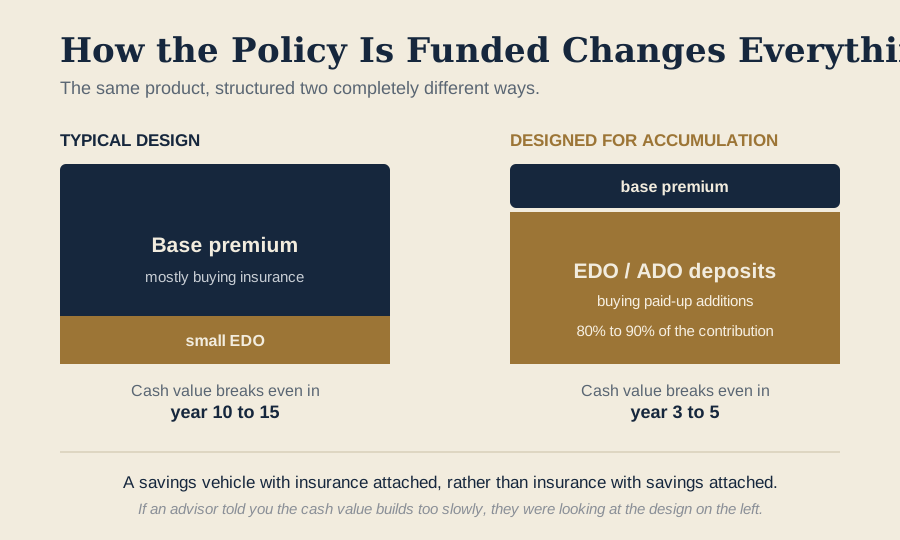
A participating policy has a base premium, the minimum needed to keep it in force. But when you're using the policy as an accumulation tool, there's a feature called the Accelerator Deposit Option, or with some insurers the Additional Deposit Option. Same thing, different brand names. It's additional cash above the minimum premium that you're allowed to pay in, and it's what supercharges cash value growth. Those funds buy paid-up additions, additional paid-up permanent insurance, which accelerates cash accumulation in the early years.
This is the difference between a policy that takes 10 to 15 years to break even on cash value and one designed the way we do it, where break-even typically lands around year three to five. For accumulation purposes, we often structure it so 80% or 90% of the total annual contribution goes to EDO rather than the base premium. The result is a savings vehicle with insurance attached rather than an insurance vehicle with savings attached. That's not a small distinction. It's the entire reason this works as a corporate asset strategy.
Two: the AAII exemption.
This is the part most people haven't heard. The growth inside a participating whole life policy doesn't count toward your Adjusted Aggregate Investment Income for purposes of the small business deduction grind. So as the cash value compounds inside your holding company, whether that's at 4%, 5%, or 6% depending on the dividend scale, none of that growth contributes to the passive income that's eroding your operating company's tax efficiency.
That's a significant structural advantage. If your corporate portfolio is pushing you toward the $50,000 threshold, or toward the $150,000 point where the deduction disappears entirely, you have two options. Accept the grind, or redirect a portion of your retained earnings into something that delivers similar long-term growth without contributing to the passive income calculation.
To be clear, this isn't a loophole or a grey area. These are standard CRA and insurance rules. Insurance growth is simply treated differently from investment income for AAII purposes. If your accountant hasn't walked you through that distinction explicitly, it isn't a failure on their part. Applying it requires a different kind of strategy conversation than what an accountant is engaged to do.
Three: the Capital Dividend Account.
At the end, when the insured person passes away, the death benefit pays to the corporation that owns the policy, tax-free. The benefit minus the policy's adjusted cost base generates a credit to the Capital Dividend Account, and money in the CDA can be distributed to shareholders as a tax-free capital dividend. Not tax-deferred. Tax-free.
So corporate capital that compounded inside the policy for 15, 20, 30, or 40 years exits the corporation through the CDA and reaches your beneficiary shareholders with no tax. Compare that to the alternative: retained earnings in a corporate investment portfolio get taxed annually, increase your passive income, grind your small business deduction, and then pass through further layers of tax before reaching your family, who receive significantly less.
The Numbers, With the Assumptions on the Table
Let's make this concrete, and be transparent about the assumptions, because the math depends entirely on them.
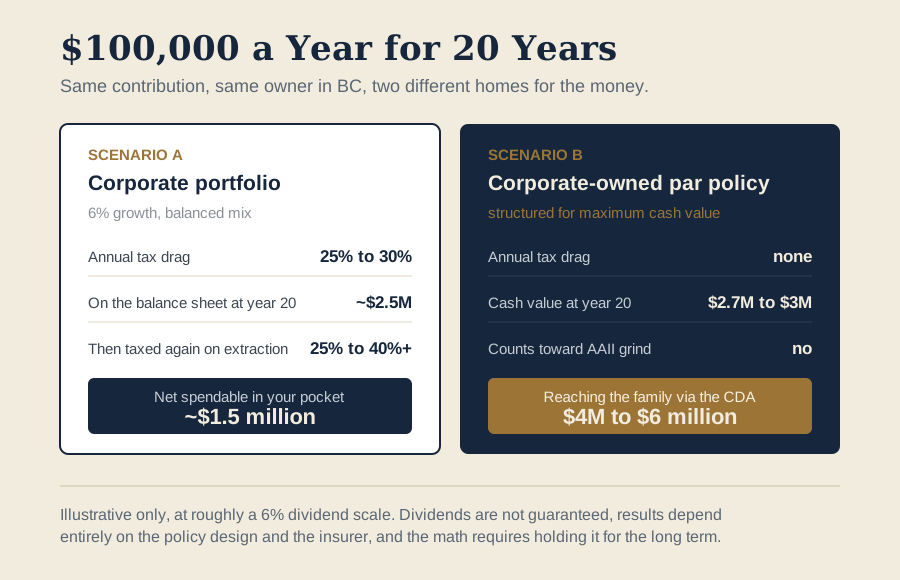
Compare two scenarios for the same incorporated owner in British Columbia. In both, the owner contributes $100,000 a year of retained earnings for 20 years.
In scenario A, the money goes into a diversified corporate investment portfolio at an assumed 6% average growth, with the income mix you'd expect from a balanced portfolio: some interest, some dividends, some capital gains. After corporate passive income tax rates apply to each type, the net effective annual tax drag lands somewhere around 25% to 30%. That's optimistic; a more interest-heavy portfolio with more bonds or GICs would be higher. Over 20 years, with that drag eating into the compounding, the account ends up around $2.5 million on the balance sheet. That's a real number and a successful outcome.
But before you can spend any of it personally, you have to get it out of the corporation. Paid to you as dividends, that's taxed personally at roughly 25% for eligible dividends in a lower bracket, to over 40% for non-eligible dividends in a top bracket. After extraction, the net spendable amount is approximately $1.5 million.
In scenario B, the same $100,000 a year goes into a corporate-owned participating whole life policy structured for maximum cash value. At roughly a 6% dividend scale, which is around where most insurers sit currently, the cash value at the 20-year mark would be somewhere around $2.7 to $3 million depending on the company. The death benefit at that same point would be considerably higher, often in the range of $4 to $6 million, depending on the insurer, your age at issue, and how it was structured.
And here's the advantage. If the insured passes away at any point, even the day after the policy starts, the entire death benefit pays to the corporation tax-free, and most of it flows through the CDA to shareholders tax-free.
Set the death benefit aside for a moment and look just at the cash. If you want to access the policy's cash value while you're alive, you typically borrow against it, either through a policy loan from the insurer or a collateral loan from a bank. That lets the corporation access capital without triggering a taxable event, while the cash value keeps compounding.
So the real comparison isn't a cash account versus a policy. It's a taxable corporate investment account that produces a fully taxed outcome when you need the money, against a tax-sheltered corporate asset that produces a largely tax-free distribution at death without disturbing the underlying compounding.
The Honest Caveats
That's all been favourable, so let's be straight about the constraints.
Past dividend scales are not a guarantee of future performance. Nobody can guarantee what the dividend will be. What we can say is that the participating accounts we work with have paid a dividend every year for a hundred years and have never missed one, and the policy design is built around having one. So you can reasonably expect it, but it isn't guaranteed.
The numbers above assume the policy is structured the way we do it, maximizing the cash inside the policy. With a poorly designed policy, or one not built for accumulation, the mechanics still work but the numbers look significantly different.
And all of this math depends on holding the policy for the very long term. These strategies don't produce results in one, two, or three years. The compounding requires time.
Understanding those constraints, the after-tax efficiency gap between a corporate investment account and a properly structured participating policy is significant. For many clients it's hundreds of thousands of dollars over 20 years, and sometimes millions.
Who This Is Genuinely For
This is definitely not for everyone, and pretending otherwise is dishonest and causes real problems.
It fits when you have retained earnings inside your corporation that aren't required for operations, typically owners with a few hundred thousand or more accumulating. It fits when you have a long time horizon, because the compounding needs decades to do its work. And it fits when you want to build wealth inside the corporation and eventually pass it to someone, usually your children, as efficiently as possible.
If you need that capital for operations, if you're early in building the business, or if your horizon is short, this isn't your tool.
Why Your Accountant Hasn't Raised It
It's worth addressing directly. If you haven't heard about this from your accountant, it isn't because they think it's a bad idea. It's because designing a corporate balance sheet strategy around life insurance isn't what they're engaged or compensated to do, and most accounting practices don't have the bandwidth to advise on insurance across hundreds of clients. That's our job. They do theirs.
When the conversation does get raised, and a properly designed policy gets brought to your accountant by someone like us, the response from competent accountants is usually that it makes sense and let's coordinate on next steps. The strategy works precisely because your accountant, your financial advisor, and the insurance specialist are aligned on what's being done and why.
So none of this is an alternative to your accountant. It's a complement to the work they're already doing, applied to a specific structural problem they typically don't address proactively. The coordination is the point.
Final Thoughts
If you're an incorporated business owner with retained earnings growing inside your corporation, you're going to run into this passive income math, and it's going to start to hurt. There's a tool that exists specifically to address it, and it's an old, vanilla, frankly boring one: a tax-sheltered allocation on your corporate balance sheet whose growth doesn't trigger passive income tax along the way, doesn't count toward the AAII calculation eroding your small business deduction, and can eventually flow through the Capital Dividend Account to your shareholder beneficiaries tax-free.
It isn't insurance in the way most people think about insurance. It's a corporate financial structure with insurance characteristics, designed for owners with a retained earnings problem, a long time horizon, and a desire to compound efficiently inside the corporation.
If that describes your situation and you suspect there's a better way to grow your corporate money, use it, and eventually pass it on, that's a conversation worth having. The first step is simply running the numbers on your situation: how your corporate capital is deployed, what your passive income exposure looks like, and whether this would actually improve your position.
To do that, book here to schedule a no-pressure Discovery Call with one of our advisors. We'll walk through your numbers, explain what we see, and tell you honestly whether this fits. If it does, we'll show you how it would be structured and what the numbers look like. If it doesn't, we'll tell you that. If you'd prefer to keep learning first, join our newsletter where we regularly break down advanced planning strategies for Canadian business owners and high-income professionals. You can also follow our YouTube here to keep up on new videos.
Key Takeaways
- The problem is two leaks, not one. Corporate investment income is taxed near 50% annually, and that same income grinds away your small business deduction five to one above $50,000, effectively making your active business income more expensive too.
- Reframe the product. Stripped of its label, a corporate-owned participating policy is a tax-sheltered fixed-income allocation on the balance sheet that happens to include insurance protection, and the strategic value is in the asset behaviour rather than the death benefit alone.
- Design determines everything. Weighting 80% to 90% of contributions to EDO deposits buying paid-up additions moves cash value break-even from year 10 to 15 down to year three to five, which is why an ordinary policy and a properly designed one look nothing alike.
- Policy growth sits outside the AAII calculation. This isn't a loophole, it's how insurance is treated under standard CRA rules, and it means you can compound corporate capital without eroding the small business deduction on your operating company.
- Dividends aren't guaranteed and time is required. The insurers we work with have paid one every year for a century, but nobody can promise future performance, and none of this math works unless the policy is held for decades.



Book Your Consultation
Book a meeting with Safe Pacific today to design a strategy that fits your goals.

Right-Sizing: Why the Best Strategy Isn't Always the Biggest or the Smallest One
Executive Summary The right strategy is the one correctly sized to what you're actually trying to accomplish, which sometimes means less than what's on the...
The Corporate Asset Your Accountant Isn't Talking About
Executive Summary A properly structured corporate-owned participating whole life policy functions less like insurance and more like a tax-sheltered fixed-income allocation on your corporate balance...

If Something Happened to You Tomorrow… Would Your Plan Actually Work?
Executive Summary: Probably not the way you think, because most business owners have the components of a plan rather than a plan designed to function...

You’re Not Paying Too Much Tax — You Just Don’t Have a Strategy
Executive Summary The tax bill that frustrates incorporated Canadians usually isn't caused by the rates, it's caused by the absence of a coordinated strategy across...

The Silent Risk in Your Portfolio
Executive Summary The silent risk is real estate concentration, where 60% to 80% of a successful Canadian's net worth sits in property that can't be...

Why High Income Isn't the Same as Financial Security
Executive Summary A high income is a resource, not a financial plan, and on its own it can hide real structural fragility behind lifestyle creep,...

Your Corporation Has Accounts You've Probably Never Seen
Executive Summary Your corporation tracks three notional accounts, the Capital Dividend Account, RDTOH, and GRIP, that never appear on a statement but directly determine how...

What Happens After You Reach Out to Safe Pacific?
Executive Summary When you reach out to Safe Pacific, a real person from our team emails you within 24 hours with a link to book...

The Protection Playbook for High-Income Employees
Here's something that surprises a lot of people. Some of the most financially fragile households we see are actually very high-income families. Not because they're...

Whole Life Insurance: The Strategy Most People Miss
Most investment portfolios are built around three pillars. You have equities, you have fixed income, and here in Canada, a lot of people have real...

Why High Earners Are More Vulnerable Than They Think
Most people assume that earning more money makes life simpler. More income, more security, more options. But the uncomfortable truth we see every day is...

How to Protect Your Income in Canada with Disability & Critical Illness Insurance
What would happen to your savings, your retirement plan, and your finances in general if you were sick or injured tomorrow and couldn't work? How...