You’re Not Paying Too Much Tax — You Just Don’t Have a Strategy

Executive Summary
The tax bill that frustrates incorporated Canadians usually isn't caused by the rates, it's caused by the absence of a coordinated strategy across your corporate structure, investments, insurance, and personal income. When four separate advisors each make reasonable decisions without talking to each other, the combined result is an unreasonable tax outcome that can cost hundreds of thousands of dollars over a decade.
We want to say something that might be a little uncomfortable. When business owners come to us frustrated about their tax bill, and this happens constantly, the first thing we tell them is that the tax isn't the problem. It's the most visible symptom of the actual problem.
And the actual problem is almost always the same. No strategy. Not that you don't have an accountant, or an advisor, or awareness. It's that you don't have a coordinated, forward-looking strategy that treats your corporate structure, your investments, your insurance, and your personal income as one system, instead of four separate things managed by four separate people who rarely talk to each other. That's what's costing you. Not the tax rate.
At Safe Pacific, we want to reframe how most Canadian business owners think about tax. The frustration is real and valid. But if you're directing that frustration at the wrong problem, you'll keep looking for solutions in the wrong places.
Why Corporate Investment Income Gets Punished
Let's start with something that surprises a lot of incorporated professionals when it's explained clearly for the first time. If you're earning money inside your corporation and then investing it, which sounds like exactly the right thing to do, the Canadian tax system is designed to penalize you for it. Not aggressively or maliciously, but systematically, year after year.
Here's how it works. When your corporation earns active business income, meaning revenue from your actual operations, it's generally taxed at the small business rate on the first $500,000 of net income, somewhere between 11% and 13% depending on your province. That's the favourable rate, and it's one of the real advantages of being incorporated.
But when you take that after-tax profit and invest it in stocks, bonds, ETFs, GICs, real estate, or other businesses, the income those investments generate is treated differently. That's called passive income, and passive income is taxed at the highest corporate rate, often around 50% depending on your province. On money your corporation already paid tax on once.
The policy rationale goes like this. The government says you already received a tax advantage by earning that income in the corporation at the small business rate instead of paying personal tax at your full marginal rate. If they let that money compound inside your corporation at the low rate, you'd have an advantage over Canadians who earn and invest personally. So the passive income rules exist to prevent a corporation from becoming a permanent tax-sheltered savings vehicle. You may not agree with that rationale, but it's the reality you're planning inside of.
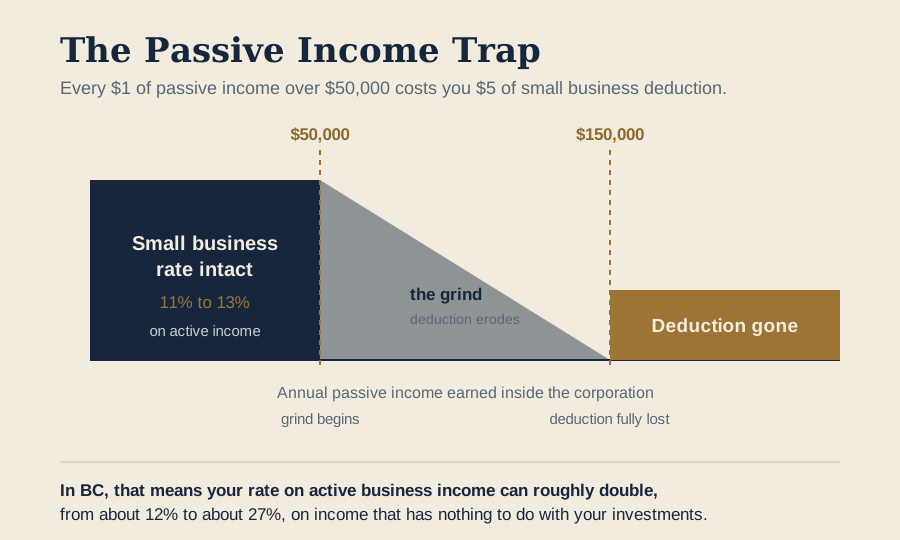
And here's where it gets worse. Once your corporation's passive investment income exceeds $50,000 a year, you start losing the small business deduction itself. The grind works like this: for every $1 of passive income above $50,000, you lose $5 of small business deduction. Which means at $150,000 of annual passive income, you lose the small business rate entirely.
So now you're not just paying high tax on your investment returns. You're paying a higher rate on your business income too. In BC, that's a jump from roughly 12% to roughly 27%, going from the small business rate to the general rate. Your tax rate on the business can effectively double because of what your investments are doing.
The Misunderstanding About "50% Tax"
This is the number that causes the most frustration, and it should. It also causes a lot of confusion. When business owners say they're paying 50% tax, they're usually describing a real experience but misidentifying what's causing it.
The Canadian system is built around a concept called integration. The idea is that whether you earn income personally or through a corporation, you should end up paying roughly the same total tax. In theory, the corporate tax plus the personal tax on your dividend extraction is calibrated to approximate what you'd have paid earning it personally in the first place.
That's the theory. In practice, integration isn't perfect. Depending on the type of income, how it was earned, when you take it out, and what province you live in, you can end up ahead of or behind where pure integration would leave you.
And here's the key point. That feeling of half of everything going to the government usually isn't a single 50% hit. It's a series of smaller hits that add up. Corporate tax on your active income. Personal tax when you take money out as salary or dividends to actually spend it. Passive income tax on what you invested in the meantime, which is probably your retirement savings. Capital gains tax when you eventually sell the business.
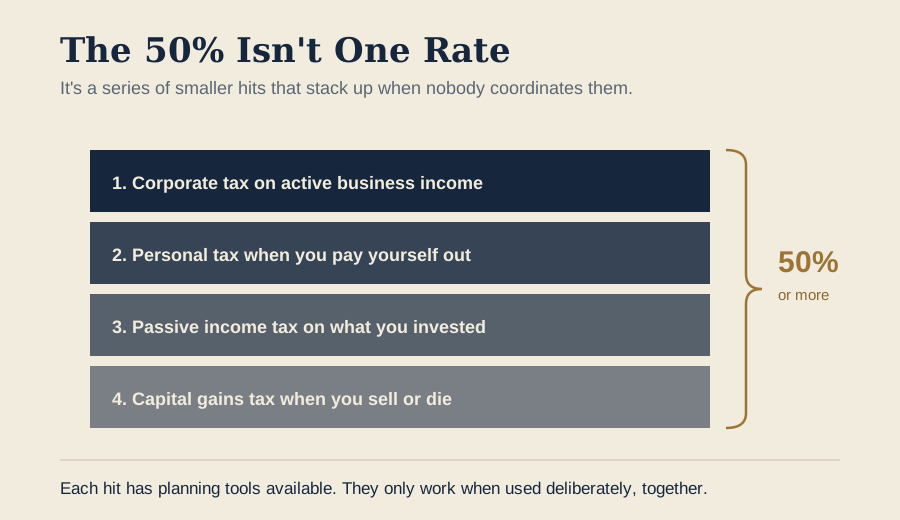
Here's the important insight. Each of those individual hits has planning tools available to reduce, defer, or sometimes eliminate it entirely. But those tools only work if you're using them intentionally, as part of a single strategy. Salary versus dividends has planning implications. The timing of when you pay yourself has planning implications. How your corporate investments are structured has planning implications. How your estate is set up for transferring to the next generation has planning implications.
None of these decisions exist in isolation. They all interact. And when they're managed independently by separate advisors who aren't communicating, you end up with a series of reasonable individual decisions that collectively produce an unreasonable total tax outcome. That's not a tax rate problem. That's a coordination problem.
The Honest Diagnosis
So why do successful incorporated Canadians overpay tax? It's not because the rates are too high, although they are high. It's not because the rules are unfair, although they are frustrating. It's because the people managing your tax outcome generally aren't working together.
Here's how a typical high-income Canadian's financial team is structured.
There's an accountant, who files the corporate and personal returns, manages compliance, handles the year-end, and sometimes does planning around specific transactions. They're good at what they do, but most accountants are looking backward at what already happened, focused on compliance first and planning second. This is actually how you tell whether you have a good one. Obviously they need to know what happened in the past to file your taxes. But you want the accountant who tells you what happens next year and in five years if you keep doing what you're doing, and what happens if you sell the house or buy something. The forward-looking ones are rarer than you'd think.
There's a financial advisor or investment manager handling your personal portfolio and maybe your corporate account. They're focused on returns, asset allocation, risk, and product selection. They typically aren't thinking about how the portfolio structure interacts with your corporate tax position or your estate plan.
There's a lawyer, who maybe set up the corporation, drafted the shareholders' agreement, or did your will. They appear when there's a specific legal task, get paid, and disappear until the next one.
And sometimes there's an insurance advisor, usually someone who sold a policy at some point and checks in periodically.
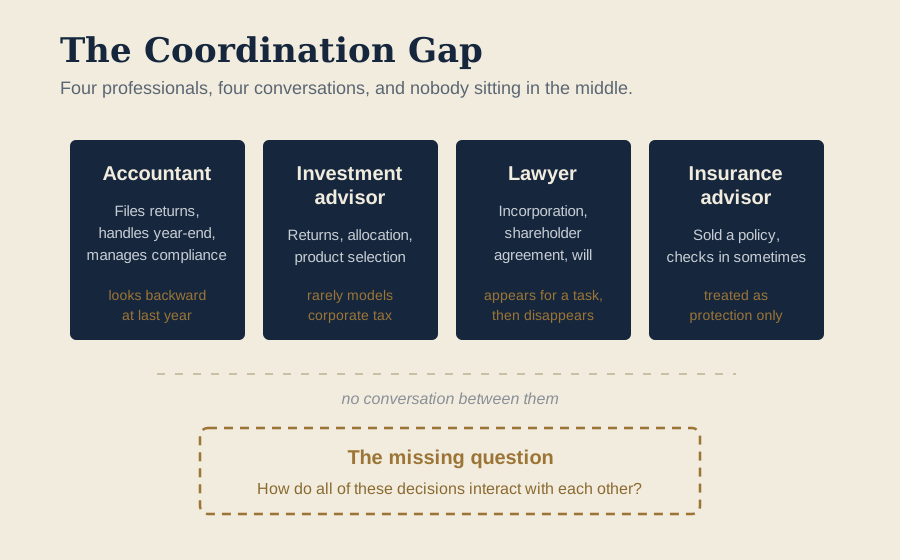
Here's a simple example of what that gap looks like in real life. Your accountant recommends paying yourself a mix of salary and dividends to balance your personal tax situation. Totally reasonable. Your investment advisor invests the corporate retained earnings in a portfolio generating significant passive income annually. Also totally reasonable. But nobody connects those two decisions to notice that the passive income from the corporate portfolio is grinding away your small business deduction, which undermines the tax efficiency of the salary and dividend structure the accountant designed. Both professionals made sensible choices. Together, those choices produce a worse outcome than either intended.
This isn't unique to one client. It's structural. It happens because the financial services industry is organized around products and specialties rather than integrated outcomes. So the fix isn't finding a better accountant or a better investment advisor. The fix is having someone in the middle whose job is to look at the whole picture and make sure the pieces work together.
What the Coordination Gap Actually Costs
Part of why this problem goes unaddressed is that it's abstract. You can't point to a line on your tax return that says coordination cost you $47,000 this year. It doesn't show up that way. But it does show up.
Take two incorporated professionals with the same income, the same type of business, the same province, everything identical. The only difference is coordination. The first has a good accountant and a good investment advisor and does the basics right: incorporated, investing the retained earnings, decent portfolio. Their tax planning is reactive, happening at year-end based on what already occurred. The second has the same starting point, but the structure is coordinated across the accountant, the advisor, and the insurance strategy. Corporate extraction is planned in advance. Investment income is managed relative to the passive income threshold. The insurance is structured to create CDA credits. The estate plan is integrated with all of it.
Over a ten-year period, with the same income and the same investment returns, the difference in after-tax wealth between those two people can be hundreds of thousands of dollars, or more. Not because the second person found loopholes or did anything aggressive. Just because every decision was designed to work with every other decision.
The money doesn't disappear in one dramatic event. It drains out slowly across dozens of small decisions over years. And the frustrating part is that at the time, each of those decisions was reasonable. The salary was set without modelling its interaction with passive income. The investments were selected without considering corporate tax treatment. The insurance was purchased for protection without leveraging it as a planning tool. The estate was structured without accounting for the eventual capital gains liability. None of those are bad decisions. They're just incomplete. And incomplete decisions, compounded over time, get very expensive.
Three Things That Close the Gap
So what does a coordinated strategy actually look like? Three concepts do most of the work. The technical complexity is honestly a distraction from what matters, which is understanding what they do and why they matter.
Corporate-to-Personal Extraction Planning.
This is simply how you get money from your corporation into your pocket, in what form, and when. Most incorporated owners have a default: salary, dividends, or some mix. It was probably set up years ago and hasn't been looked at since. But the right answer changes based on your personal income this year, your corporation's income this year, your RRSP room, what's happening with your passive income, and how your retirement income will compare to today. This isn't a decision you make once. It's a decision you should revisit every year based on that year's circumstances. The difference between an optimized extraction strategy and a default can be tens of thousands of dollars annually, which compounds into hundreds of thousands over a career.
Your CDA and RDTOH.
Inside your corporation are what the tax system calls notional accounts, essentially invisible ledgers tracking certain tax-advantaged amounts your corporation has accumulated. Two matter most. The Capital Dividend Account, or CDA, tracks amounts your corporation can pay out to shareholders completely tax-free, not tax-deferred. What flows into it includes the non-taxable half of a capital gain and life insurance proceeds received by the corporation above the policy's adjusted cost base. The other is RDTOH, a refund mechanism that lets your corporation recover some of the high passive income tax it paid when it pays out a taxable dividend, which exists to prevent double taxation.
Why do these matter? Because most incorporated business owners have no idea how much sits in either account. Money in your CDA can be distributed to you tax-free right now, if someone is paying attention and telling you it's there. This is one of the most common coordination gaps we see. The accountant knows about the CDA, but nobody is actively flagging when the balance is large enough to justify a distribution, or structuring corporate activity to maximize those credits over time. That's not a tax rate problem. That's an attention problem.
Insurance as Part of your Tax Architecture.
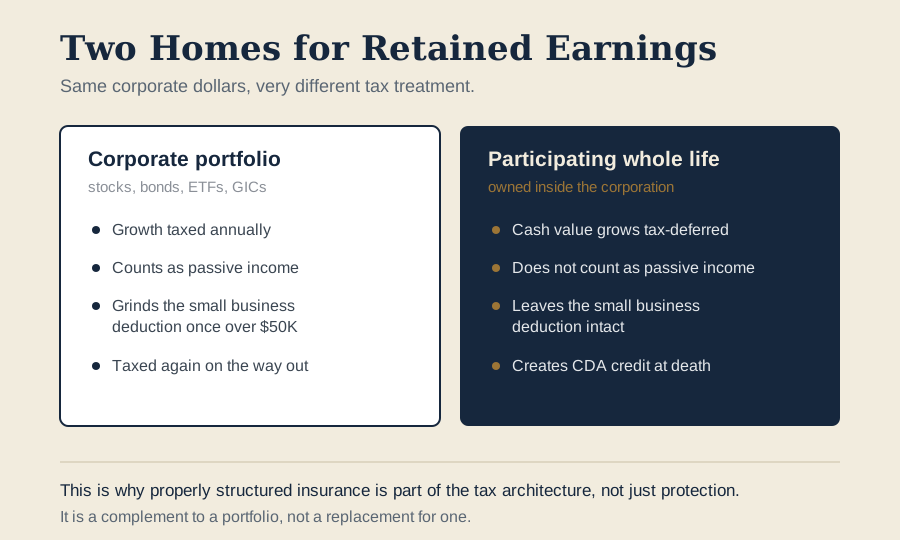
This one surprises people, because most owners think of insurance purely as protection, something you buy in case you die. But a properly structured participating whole life policy inside your corporation is also a significant tax planning tool.
Here's why. When your corporation owns the policy and the insured person dies, the death benefit pays to the corporation, and any amount above the policy's adjusted cost base creates a CDA credit that can then be distributed to shareholders tax-free. So instead of retained earnings eventually leaving the corporation as a dividend taxed at 40% or more, they can flow out through the CDA as a tax-free capital dividend to your family.
But the insurance doesn't only create value at death. While you're alive, the cash value inside the policy grows tax-deferred, and that growth does not count toward passive income. Which means it doesn't grind down your small business deduction the way a corporate investment portfolio does. Your wealth can build inside the corporation efficiently, without triggering the passive income rules, and eventually pass to your family tax-free through the CDA.
What This Looks Like in Practice
Consider an incorporated dentist, 15 years into her practice. She has a professional corporation with retained earnings building up, a personal investment account, an RRSP, and a TFSA. She's been paying herself a mix of salary and dividends, with the split set when she first incorporated and untouched since. Her corporate investment portfolio is around $900,000, generating roughly $40,000 a year in passive income. She has a will, a basic corporate structure, a financial advisor managing the portfolio, and an accountant doing her returns.
She feels like she's paying a lot of tax. Her accountant tells her the numbers are normal for her income level. She leaves the office frustrated and unsure what to do about it. That's a familiar experience for a lot of people.
Here's what a coordinated review found.
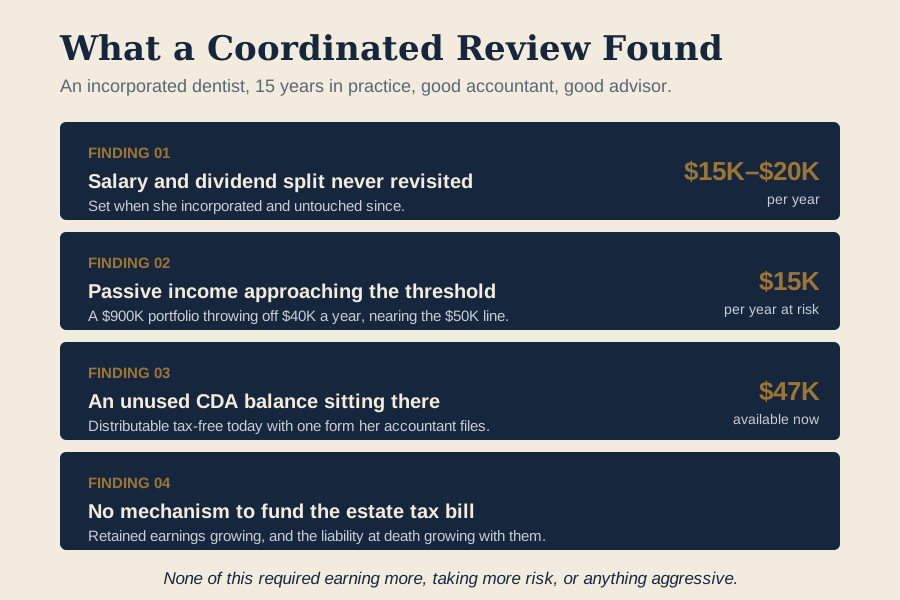
The salary and dividend split hadn't been modelled against her current personal income in years, and restructuring the mix could save $15,000 to $20,000 in combined personal and corporate tax annually. Her corporate portfolio was approaching the $50,000 passive income threshold, and crossing it without adjustment would start costing her the small business deduction, potentially another $15,000 a year in corporate tax. Her CDA had a $47,000 balance her accountant knew about but nobody had advised her to distribute, money she could take out tax-free today with a simple form. And there was no insurance strategy inside the corporation, so while the retained earnings grew, so did the estate tax liability, with no mechanism to fund it other than forcing her estate to liquidate.
None of these issues required her to earn more, take investment risk, or do anything aggressive or offshore. All four existed because the advisors in her life were each doing their own job well, in silos, without connecting the dots for one another.
A coordinated plan addresses all four. The extraction strategy gets restructured and reviewed annually. The corporate portfolio is adjusted to keep passive income below the threshold, partly by redirecting some retained earnings into a participating whole life policy that builds tax-deferred cash value without triggering the passive income rules. The CDA balance gets distributed and put to use. And that same insurance policy creates a long-term estate tax funding mechanism while building future CDA credits. Over ten years, without changing her income, her investment returns, or her lifestyle, conservatively that's hundreds of thousands of dollars back in her pocket.
Why This Doesn't Get Fixed
Let's be transparent about why this persists. Coordinated planning isn't a new concept, and it's well understood within the financial services industry. The problem is structural.
Information lives in silos and only gets examined occasionally. Everyone is paid for their specific piece, and nobody is really paid for the strategy that connects them. And the timing is backwards: planning conversations that should be proactive end up happening reactively. After the huge tax bill arrives, people ask how to avoid it, and by then it's too late. After a major life event or health event, people try to fix things, but most of the options are already gone and the damage is done.
To be clear, this isn't a criticism of accountants or investment advisors. They're all doing what they're supposed to do. The point is to give business owners a different way to frame the question. Not "how do I reduce my taxes," but "is my entire financial situation designed to work together in a way that minimizes what I hand to the CRA, now, when I retire, when I sell the business, and when I die?"
If the answer is yes, you're coordinated, you're likely in better shape than most. If the answer is that nobody has actually looked across your whole picture, that's a conversation worth having. And it's worth having before you need to, because once you need to, your options are limited and the solutions are considerably more expensive.
Who This Is For, and Who It Isn't
Coordinated planning of this kind isn't for everyone, and it's worth being upfront about that.
If you're an early-stage business owner still growing, without significant profit or retained earnings yet, your priority is building the business rather than optimizing the structure around it. There will be a time for this conversation, and it's probably not today.
If you're a high-income employee who isn't incorporated, many of these specific tools simply aren't available to you. There are still valuable planning strategies worth discussing, but the corporate mechanisms here are for incorporated people.
If you're an incorporated professional or business owner, a dentist, physician, lawyer, engineer, consultant, software founder, or entrepreneur, with retained earnings accumulating, an investment portfolio generating passive income, and an estate getting more complex as your wealth grows, then this is directly relevant. And the earlier you have the conversation, the more options you have and the less it costs.
After more than 15 years of doing this, here's the pattern. The clients who feel most in control of their tax situation are never the ones who found a magic strategy or the perfect product. They're the ones who stopped treating tax as an annual event and started treating it as a long-term challenge requiring a long-term coordinated response.
Final Thoughts
Most Canadian business owners who feel like they're paying far too much tax aren't wrong to be frustrated. But that frustration is usually pointed at the tax rate when a meaningful part of it could be fixed with coordination.
The passive income trap is real and it gets expensive quickly, and there are ways to manage it. The coordination gap between your advisors is real, and it's addressable. Your extraction strategy can almost always be better optimized. Your CDA and RDTOH are tools most people aren't using deliberately or often enough. And insurance structured properly inside the corporation isn't just protection, it's part of your tax architecture.
None of this is aggressive planning. None of it is a grey area or a loophole. All of it is built into the Canadian tax system and designed to be used. But it only works when the pieces are coordinated, when someone is looking at the whole picture and making sure your individual decisions add up to a strategy rather than a series of reasonable choices that collectively produce an unreasonable result.
That's what we do. We're not your accountant and we're not your lawyer. We work with your accountant and your lawyer, and we sit in the middle making sure the strategy is connected.
If you want a coordinated review of your corporate and personal picture, what's working, what isn't, and what's being left on the table, book here to schedule a no-pressure Discovery Call with one of our advisors. We'll look at the full structure, run the numbers, and identify the gaps. No product recommendations and nothing to buy, just a straight assessment of whether your structure is working the way it should. If you'd prefer to keep learning first, join our newsletter where we regularly break down advanced planning strategies for Canadian business owners and high-income professionals. You can also follow our YouTube here to keep up on new videos.
Key Takeaways
- The tax rate is the symptom, not the disease. What feels like a single 50% hit is really corporate tax, personal tax on extraction, passive income tax, and capital gains stacking up, and each layer has planning tools that only work when used together.
- Passive income quietly attacks your business income. Every dollar of passive income above $50,000 costs you five dollars of small business deduction, and at $150,000 it's gone entirely, potentially doubling the rate on your active business income.
- Four good advisors in silos produce a bad outcome. Your accountant's salary and dividend plan can be undermined by your investment advisor's portfolio, and neither will notice because nobody is asking how the decisions interact.
- Most owners don't know what's sitting in their CDA. Those balances can often be distributed tax-free today, but only if someone is tracking them and flagging when a distribution makes sense.
- Corporate insurance is tax architecture, not just protection. Cash value inside a participating policy grows tax-deferred without counting as passive income, preserving your small business deduction while building CDA credits for a tax-free transfer later.



Book Your Consultation
Book a meeting with Safe Pacific today to design a strategy that fits your goals.

The Trapped-Cash Problem
Executive Summary Surplus profit sitting in a corporate bank or investment account is quietly taxed twice, once on the investment income at close to 50%...

Right-Sizing: Why the Best Strategy Isn't Always the Biggest or the Smallest One
Executive Summary The right strategy is the one correctly sized to what you're actually trying to accomplish, which sometimes means less than what's on the...

The Corporate Asset Your Accountant Isn't Talking About
Executive Summary A properly structured corporate-owned participating whole life policy functions less like insurance and more like a tax-sheltered fixed-income allocation on your corporate balance...

If Something Happened to You Tomorrow… Would Your Plan Actually Work?
Executive Summary: Probably not the way you think, because most business owners have the components of a plan rather than a plan designed to function...
You’re Not Paying Too Much Tax — You Just Don’t Have a Strategy
Executive Summary The tax bill that frustrates incorporated Canadians usually isn't caused by the rates, it's caused by the absence of a coordinated strategy across...

The Silent Risk in Your Portfolio
Executive Summary The silent risk is real estate concentration, where 60% to 80% of a successful Canadian's net worth sits in property that can't be...

Why High Income Isn't the Same as Financial Security
Executive Summary A high income is a resource, not a financial plan, and on its own it can hide real structural fragility behind lifestyle creep,...

Your Corporation Has Accounts You've Probably Never Seen
Executive Summary Your corporation tracks three notional accounts, the Capital Dividend Account, RDTOH, and GRIP, that never appear on a statement but directly determine how...

What Happens After You Reach Out to Safe Pacific?
Executive Summary When you reach out to Safe Pacific, a real person from our team emails you within 24 hours with a link to book...

The Protection Playbook for High-Income Employees
Here's something that surprises a lot of people. Some of the most financially fragile households we see are actually very high-income families. Not because they're...

Whole Life Insurance: The Strategy Most People Miss
Most investment portfolios are built around three pillars. You have equities, you have fixed income, and here in Canada, a lot of people have real...

Why High Earners Are More Vulnerable Than They Think
Most people assume that earning more money makes life simpler. More income, more security, more options. But the uncomfortable truth we see every day is...


