If Something Happened to You Tomorrow… Would Your Plan Actually Work?

Executive Summary:
Probably not the way you think, because most business owners have the components of a plan rather than a plan designed to function under pressure, and plans fail in three predictable places: outdated documents, no cash at the moment it's needed, and nobody who knows enough to execute it. What separates a plan that performs from one that collapses isn't the documents or the assets, it's coordination, and someone whose job is to own the whole picture.
Most people think the goal of estate planning is to have the right documents. Your will, your power of attorney, your corporate structure, your insurance. Get those in place and you're covered.
What nobody tells you is that documents don't execute themselves. Documents don't make phone calls. They don't coordinate with your accountant. They don't know that the life insurance you bought eight years ago is still in your personal name instead of your company's. They don't flag that your will references assets that were restructured into a corporation three years ago and don't exist anymore in the way the will describes.
Documents are static. Life moves. And the gap between a static document and a dynamic financial reality is exactly where an estate plan falls apart.
At Safe Pacific, we want to talk about what it actually takes for a financial plan to work rather than simply exist, and to work at the moment it's supposed to perform.
Components Are Not the Same as a Plan
Let's give credit where it's due. The business owners and incorporated professionals we work with are not irresponsible people. They're the opposite: organized, successful, and they've thought about their finances more than most Canadians ever will. Most have a will. Most have some life insurance. Most have a corporate structure, an operating company, maybe a holding company, maybe a trust. Most have an accountant they've worked with for years and a financial advisor managing the investments.
On paper, that's a plan. And in a lot of ways it isn't a bad one. But there's an important distinction between having the components of a plan and having something designed to function under pressure.
A will is a document. It tells people what you want to happen when you pass away, but it doesn't fund anything. It doesn't pay the taxes. It doesn't provide cash to your family while the estate is settling and going through probate. It doesn't resolve the questions that arise around corporate assets, retained earnings, or a shareholders' agreement when there's a partner involved.
Life insurance is a financial tool. It pays a death benefit, but only if the policy is in the right name, owned by the right entity, with the right beneficiary designation, and sized to actually cover the liabilities the estate will face.
A corporation is a structure. It can deliver significant tax advantages, but at death it also creates complexity: a deemed disposition, corporate tax obligations, possibly a shareholder buy-sell requirement that needed to be planned for in advance to resolve cleanly.
And your accountant does excellent work, but accounting is largely backward-looking, focused on last year and on compliance.
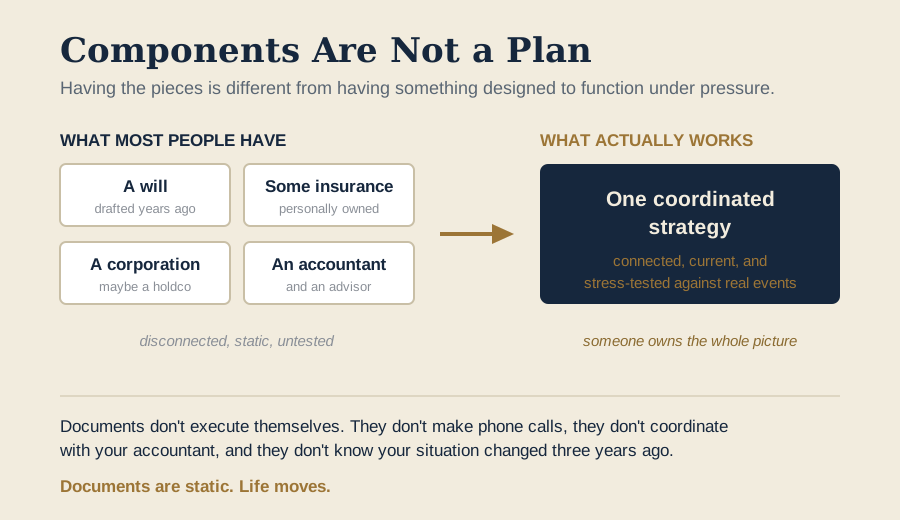
So what happens if you're disabled for 18 months? What happens if you die suddenly at 54? What happens if your business partner wants to exit the same year you have a major heart attack? Most plans haven't been tested against those questions, and the untested ones create the most chaos when the questions stop being hypothetical.
What Happens If You Become Disabled
Let's start with the scenario that gets far less attention than it deserves. Not death. Disability. In many ways a long-term disability is more financially disruptive to a business than a death, and it happens more often. A Canadian in their forties is statistically more likely to experience a disability lasting more than 90 days before age 65 than to die. That's not a scare tactic, it's actuarial reality.
For business owners specifically, the consequences are messier than they are for employees. When an employee can't work, their employment income stops and a group disability plan typically kicks in at 60% to 70% of salary. Not ideal, but clear.
When a business owner becomes disabled, the income stops or drops significantly depending on how dependent the corporation is on you. But the bills don't stop. The mortgage, the staff, the lease, the loan payments, the software licences. And here's the part that creates real chaos: the decisions don't stop either. The corporation still needs to be managed. Someone still has to sign on the corporate accounts. The taxes still come due. If you have a partner, does the partnership continue?
If you're incapacitated but not dead, who has the authority to make those decisions? This is where most plans reveal the gap. A personal will only takes effect when you die, so it does nothing during a disability. A personal power of attorney addresses personal decisions and personal finances, and it doesn't automatically extend to your corporate decision-making authority unless your shareholders' agreement and corporate bylaws specifically address what happens when a shareholder or key decision-maker becomes incapacitated. Businesses can end up in genuine operational paralysis while the owner lies in a hospital bed. We've seen it happen. It isn't theory.
Layered on top of the operational disruption is the financial one. Without individual disability insurance designed for business owners, with an own-occupation definition that keeps paying even if you could technically do some other kind of work, your income replacement can be far less than you assumed. And a group benefits plan typically maxes out after two years, after which you're on your own. What does your financial plan look like if your income drops 70% for three years? Most people never model it, and when they do, the answer isn't pleasant. Disability is the scenario most business owners believe is covered and the one that most consistently turns out to have meaningful gaps.
What Happens If You Die Unexpectedly
This is the scenario most people believe they've planned for, and it also carries expensive gaps. Here's what actually happens in the period immediately following the unexpected death of a business owner, not the idealized paper version.
The day it happens, there's shock. Within days, practical questions start emerging whether the family is ready or not.
Bank accounts: who can sign? If the primary business account is in your name and the corporation's signing authority was never updated, your family and your business may not be able to access the corporate accounts while the estate is being settled. That creates immediate problems inside the business.
The business itself: you have employees, clients, contracts, obligations. Someone needs to manage those immediately. Who? If you have a partner, what are their rights and obligations? If you don't, who steps in?
The shareholders' agreement: does it clearly address what happens to your shares if you pass away, or your partner's shares if they do? Is there a buy-sell provision, and is there money to fund it? If your operating company shares pass to your spouse through the will, but your spouse has no interest or ability to run the business, and there's no mechanism for the other partners to buy them out at a fair valuation, the situation gets complicated fast, with different expectations on all sides.
The tax bill: dying in Canada triggers a deemed disposition, where the CRA treats all your assets as sold at fair market value on the day you died. For an owner with significant corporate holdings, real estate, or an investment portfolio, that capital gains liability can run into the hundreds of thousands or millions. And it's due by April 30th of the following year, not somewhere down the road. If the estate has no liquid cash, and most don't because the wealth is concentrated in a business or real estate that takes time to sell, your family is under pressure to sell something fast, on a compressed timeline, in an already stressful situation. That's a forced liquidation under conditions nobody would choose.
Your RRSP: if there's no spouse to roll it over to, the entire balance becomes fully taxable income in the year of death. On an $800,000 RRSP, which isn't unusual for a successful professional, that can add roughly $300,000 to the final tax bill.
All of this lands while your family is grieving, making funeral arrangements, managing children, trying to keep working, and trying to hold it together emotionally. The financial chaos arrives on top of the personal chaos.
And here's the part that matters most: almost all of it is preventable. Not the grief and not the loss. But the chaos, the forced sale of real estate or the business, the tax bill arriving with no money to pay it. That's a planning problem, and planning problems are solvable in advance.
The Three Gaps
In our experience, plans fail under pressure for three reasons. Once you see them, you can't unsee them.
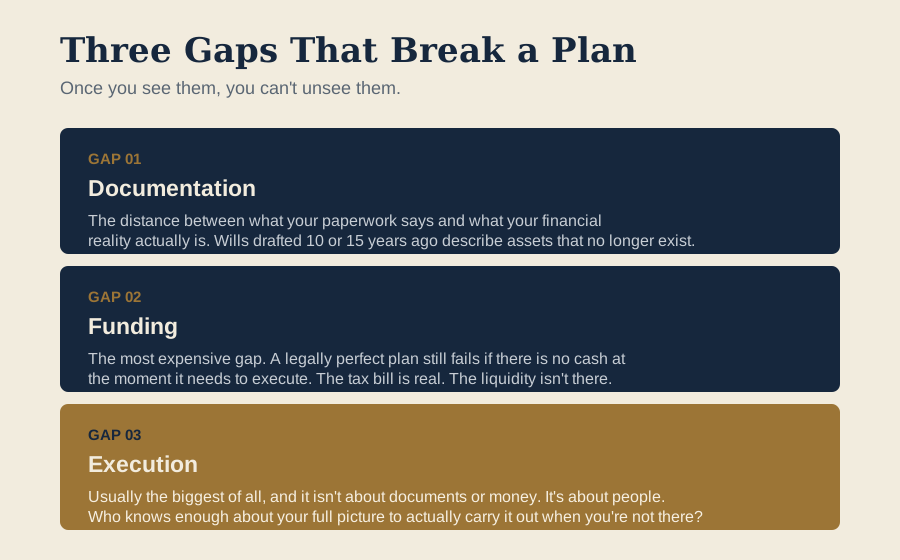
Documentation.
Your will, power of attorney, representation agreement, and shareholders' agreement reflect your life as it was when they were created. Ideally they've been updated. Usually they haven't. For most owners they were drafted when the corporation was set up, or when they bought a house, or had a child, which for many people was 5, 10, 15, or 20 years ago. Since then the corporation may have been restructured, a holding company added, real estate bought or sold. The family situation may have changed, with a new spouse, stepchildren, kids who were minors and are now adults. The business may be worth several times more. But the documents sat in a drawer. So when the estate is settled, the executor works from documents describing a financial situation that no longer exists. Beneficiary designations on insurance policies and RRSPs may name people who are no longer in the picture. For a business owner with an actively evolving structure, this gap is larger than anyone realizes until it's tested.
Funding.
This is the most expensive gap. A plan can be legally perfect, with the right documents, the right structures, and the right intentions, and still fail catastrophically because there's no money at the moment it needs to execute. The tax bill is real but there's no cash. The buy-sell agreement requires the partners to purchase your shares, but the insurance meant to fund it was never put in place, or was set up a decade ago when the business was worth far less, or was structured incorrectly. The estate needs time to settle properly, but the family needs money now. Liquidity at the right moment is what makes a plan functional rather than theoretical, and for many owners the question of where the money actually comes from has never been clearly answered.
Execution.
This one surprises people, because it isn't about documents or money. It's about people. Who actually knows enough about your full financial picture to execute the plan when you're not there? Your will names an executor, but does that person know where the corporate documents are? Do they know your accountant's name? Do they know there's a holding company, or a shareholders' agreement that needs to be triggered? A power of attorney may authorize someone to make decisions, but do they understand the corporate structure well enough to make good ones? Do they know who to call? Your accountant knows your tax situation, but do they know your insurance picture or what's in the will? This is the gap between what the plan says should happen and what the people responsible actually know how to do. It's usually the biggest gap of all, because even with perfect documents and adequate funding, if the right people don't know the right things at the right time, execution falls apart.
Why Insurance Is Really About Liquidity
Life insurance is almost universally described as protection. But in a business owner's plan, its real function is liquidity: a specific, predetermined amount of cash arriving at exactly the moment it's needed.
Consider what doesn't wait. The CRA doesn't wait. Your family's living expenses don't wait. Your partner's buyout doesn't wait for your investment portfolio to recover from a drop, and it doesn't wait for your executor to sort through thousands of pages. These obligations arrive, and they arrive now.
The only financial tool that delivers a precise, predetermined amount of money at that moment regardless of what markets are doing is life insurance. Not real estate, which is slow. Not the investment portfolio, which might be down in the year you need it. Not corporate retained earnings, which carry their own tax problem when you pull them out.
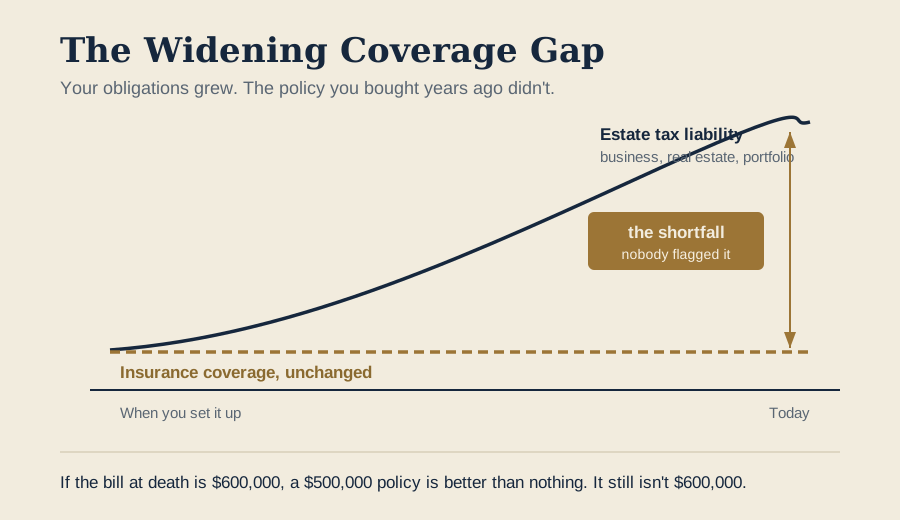
But here's what most people get wrong. The insurance has to be the right amount, structured to match the actual obligation. If your capital gains bill at death is $600,000, the insurance needs to be $600,000. That $500,000 policy you bought when your estate was smaller is still worth having, but it doesn't cover $600,000. If your shareholders' agreement requires a $1.2 million buyout, the insurance needs to be $1.2 million, not the $800,000 that felt comfortable 15 years ago. If your family needs 18 months of income while the estate settles, that money has to come from somewhere.
Ownership matters just as much as amount. A policy owned personally that should be owned corporately misses the chance to create a Capital Dividend Account credit, which is what allows retained earnings to reach your family tax-free. A policy owned corporately that should be personal creates tax complications for whoever you wanted the money to go to. And a policy with beneficiary designations that no longer match the estate plan, because the plan was updated and the insurance wasn't, causes serious problems in blended families where an ex-spouse may still be named.
Getting the insurance right means three things: the right amount matched to the obligations your estate will actually face, the right structure and ownership with correct designations integrated with your corporate tax plan, and regular review as your picture evolves. When those are in place, insurance stops being a product you bought and left, and becomes an engineered liquidity tool that makes everything else in the plan work.
Structure Reduces Chaos, Not Just Tax
When business owners discuss corporate structure, a holding company, a shareholders' agreement, an estate freeze, a family trust, the conversation is usually about tax efficiency. That's where most accountants and planners take it, and tax efficiency matters. But structure does something else that matters just as much when life doesn't cooperate. It reduces chaos.
Compare two business owners.
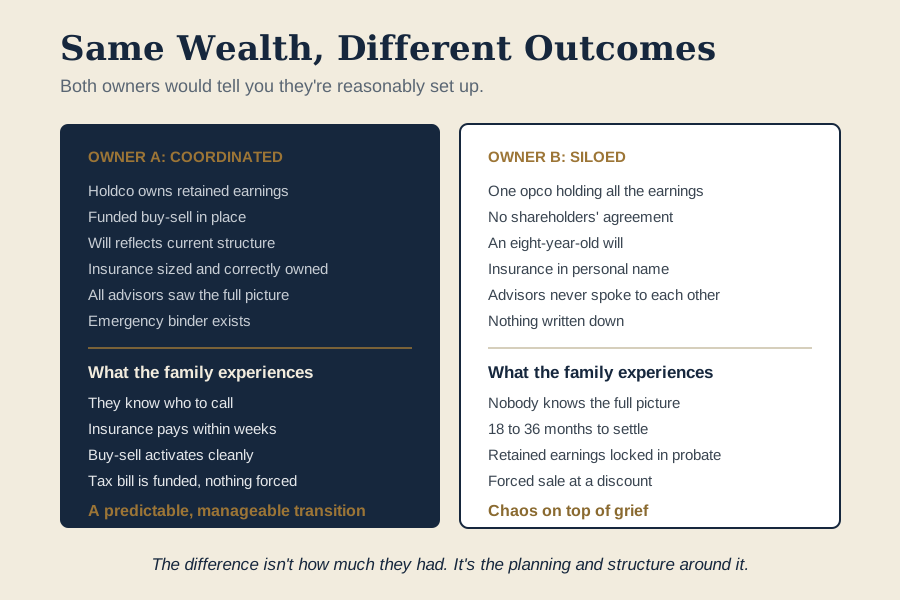
The first has an operating company and a holding company, with the holdco owning the retained earnings and investment assets. There's a shareholders' agreement with a clearly funded buy-sell provision. The will is current and references the actual corporate structure. The insurance is owned by the holding company, sized to the estimated estate tax liability, with beneficiary designations set to flow through the Capital Dividend Account. The accountant, lawyer, and financial advisor have all seen the full picture within the last 18 months. And there's a document, sometimes called a family emergency binder, outlining where everything is and who to call.
The second has a single operating company holding significant retained earnings. No holding company, no shareholders' agreement. An eight-year-old will. Life insurance in their personal name, bought around the time they got their mortgage more than a decade ago. An accountant handling taxes, an advisor managing the RRSP, and a lawyer they haven't spoken to since the will was drafted. Nothing written down about what should happen if something goes wrong.
Both have assets. Both have some planning in place. Both would tell you they're reasonably set up. But when the unexpected happens, the experience for their families is completely different.
The first family has clarity. They know who to call. The executor has a document explaining the corporate structure. The insurance pays within a couple of weeks, giving them cash to work with. The shareholders' agreement activates cleanly. The tax bill is funded. The estate settles in a predictable, manageable way.
The second family faces chaos. Nobody knows the full picture. The estate takes 18 to 36 months to settle because the corporate structure wasn't properly addressed in the will. The insurance is in the wrong name with tax consequences nobody planned for. The retained earnings in the operating company aren't accessible because the estate is in probate. And there's a forced sale of business assets, usually at a discount, because the tax bill came due and there was no other money to pay it.
Same wealth. Same intentions. The difference is the planning and the structure around it.
Somebody Has to Be the Quarterback
Here's how most financial planning relationships work. You have an accountant handling tax and compliance, who knows your numbers better than anyone. A lawyer who drafted the will and corporate documents and handles legal tasks as they arise. A financial advisor managing the investments, who understands your risk tolerance and objectives. And maybe an insurance advisor who sold you coverage at some point and checks in occasionally.
Four professionals, all competent, all doing their specific job well. The problem is that none of them owns the full picture, and none is accountable for making sure the whole thing is coherent.
The accountant doesn't know your exact insurance coverage or whether it's structured correctly to solve the estate liability. The lawyer doesn't know whether the structure they set up three years ago still reflects your situation. The financial advisor doesn't know whether the investment strategy inside your holding company is creating a passive income problem eroding your small business deduction. The insurance advisor doesn't know whether the beneficiary designations from eight years ago still match the estate plan.
Nobody is sitting in the middle.
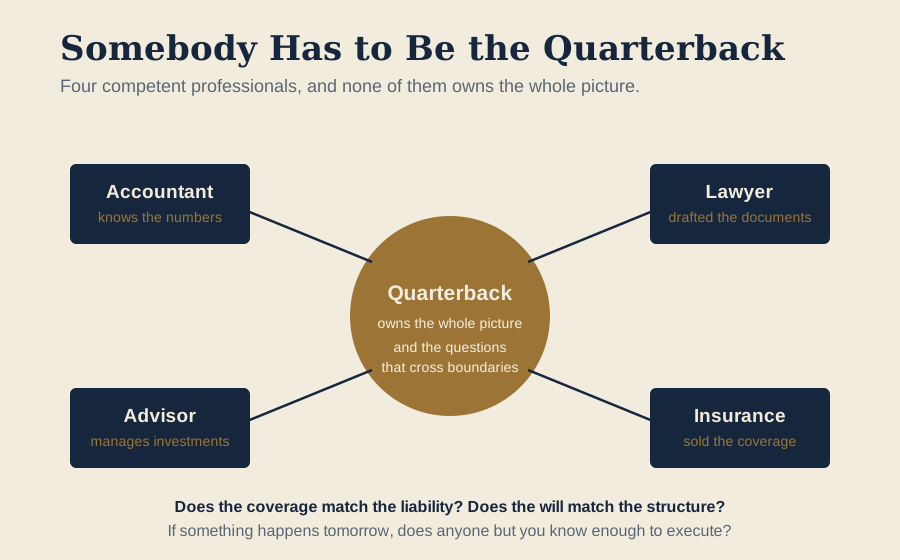
The quarterback's job is to ask the questions that cross boundaries. Does the insurance coverage match the estate liability? Does the will reflect the current corporate structure? Is the investment strategy creating a passive income problem? Does the shareholders' agreement have an updated and funded buy-sell provision? And if something happens tomorrow, does anyone other than you know enough about this plan to actually execute it?
Those questions don't belong to any single professional. They belong to whoever is looking at the whole picture. That's the role we play. We're not your accountant and we're not your lawyer, and we're not trying to be, because both of those relationships are essential. We work with them, and if you don't have good ones, we can introduce you. But we sit in the middle making sure the whole strategy is coherent rather than just each silo making sense on its own. And we end up being the ones who push back with the uncomfortable questions before you have to ask them, because once you must ask them, it's too late.
Final Thoughts
Most successful business owners have a will, some insurance, a corporation, and the genuine intention to do all of this properly. But the pieces aren't connected. They haven't been updated. They've never been tested against real scenarios. The funding isn't secured. And nobody has addressed who will actually carry it out.
The documents from eight years ago, or fifteen, or four, were probably great at the time and made sense then. Your financial situation today is different. The result of leaving it there is a plan that looks solid right up until you need it, at which point you aren't there to fix it, and everyone else has to work it out without knowing what was in your head.
It's also worth having this conversation beyond yourself. If your parents are still here, ask whether their will from fifteen years ago is current. Did they sell the house? Are there grandchildren who didn't exist when it was written? And make sure your spouse's affairs are in order too, because if something happens to them, every problem described here becomes yours.
If you're a business owner, incorporated, or a high-income professional in Canada, and you want an honest assessment of whether your plan would actually work if something happened tomorrow, book here to schedule a no-pressure Discovery Call with one of our advisors. We'll walk through the full picture, the documents, the funding, the structure, and the execution, and we'll ask the uncomfortable questions most people don't bring up. If you're in good shape, we'll tell you that. If you'd prefer to keep learning first, join our newsletter where we regularly break down advanced planning strategies for Canadian business owners and high-income professionals. You can also follow our YouTube here to keep up on new videos.
Key Takeaways
- Having the components isn't having a plan. A will doesn't fund anything, insurance only works if it's the right amount in the right name, and a corporation adds complexity at death. What's usually missing is coordination, not pieces.
- Disability is the more likely disruption and the least planned for. A Canadian in their forties is statistically more likely to face a disability lasting over 90 days than to die, and a personal will and power of attorney do nothing for corporate decision-making authority while you're incapacitated.
- Plans fail in three places. Documents that describe a financial reality that no longer exists, no liquidity at the moment the plan must execute, and nobody who knows enough about the full picture to carry it out.
- Your coverage gap widens quietly every year. The policy sized to your obligations a decade ago doesn't cover today's estate tax bill or buy-sell requirement, and typically nobody flags it until the worst possible moment.
- Structure reduces chaos, not just tax. Two owners with identical wealth can leave their families either a predictable transition or an 18-to-36-month settlement with a forced sale at a discount. The difference is coordination and someone accountable for the whole picture.



Book Your Consultation
Book a meeting with Safe Pacific today to design a strategy that fits your goals.
The Trapped-Cash Problem
Executive Summary Surplus profit sitting in a corporate bank or investment account is quietly taxed twice, once on the investment income at close to 50%...

Right-Sizing: Why the Best Strategy Isn't Always the Biggest or the Smallest One
Executive Summary The right strategy is the one correctly sized to what you're actually trying to accomplish, which sometimes means less than what's on the...

The Corporate Asset Your Accountant Isn't Talking About
Executive Summary A properly structured corporate-owned participating whole life policy functions less like insurance and more like a tax-sheltered fixed-income allocation on your corporate balance...
If Something Happened to You Tomorrow… Would Your Plan Actually Work?
Executive Summary: Probably not the way you think, because most business owners have the components of a plan rather than a plan designed to function...

You’re Not Paying Too Much Tax — You Just Don’t Have a Strategy
Executive Summary The tax bill that frustrates incorporated Canadians usually isn't caused by the rates, it's caused by the absence of a coordinated strategy across...

The Silent Risk in Your Portfolio
Executive Summary The silent risk is real estate concentration, where 60% to 80% of a successful Canadian's net worth sits in property that can't be...
Why High Income Isn't the Same as Financial Security
Executive Summary A high income is a resource, not a financial plan, and on its own it can hide real structural fragility behind lifestyle creep,...

Your Corporation Has Accounts You've Probably Never Seen
Executive Summary Your corporation tracks three notional accounts, the Capital Dividend Account, RDTOH, and GRIP, that never appear on a statement but directly determine how...

What Happens After You Reach Out to Safe Pacific?
Executive Summary When you reach out to Safe Pacific, a real person from our team emails you within 24 hours with a link to book...

The Protection Playbook for High-Income Employees
Here's something that surprises a lot of people. Some of the most financially fragile households we see are actually very high-income families. Not because they're...

Whole Life Insurance: The Strategy Most People Miss
Most investment portfolios are built around three pillars. You have equities, you have fixed income, and here in Canada, a lot of people have real...

Why High Earners Are More Vulnerable Than They Think
Most people assume that earning more money makes life simpler. More income, more security, more options. But the uncomfortable truth we see every day is...


