
Executive Summary
The silent risk is real estate concentration, where 60% to 80% of a successful Canadian's net worth sits in property that can't be converted to cash quickly, on your timeline, or without a large tax bill. The fix isn't selling what you've built, it's adding liquidity, diversification without disposition, and insurance-funded estate tax planning alongside the real estate.
Real estate has probably been the best investment you've ever made, and we're not here to argue with that. If you bought property in Canada in the last 20 or 30 years in Vancouver, Toronto, Calgary, or anywhere with a pulse, you've likely done well. Some of our clients have done better in real estate than they ever did in their stock portfolios.
So this isn't about telling you real estate was a mistake. It's about asking a different question, one that many advisors are too polite or too uncomfortable to raise. What happens when the thing that built your wealth becomes the thing that traps it?
For a lot of successful Canadian business owners, incorporated professionals, and high-income earners, that's exactly where things are headed. Not because they made bad decisions, but because they made a very good decision and then kept making it without building anything else around it. At Safe Pacific, we want to talk about real estate concentration risk, and specifically what it means for your retirement, your liquidity, and your ability to actually access the wealth you've spent decades building.
Why This Happens, and Why It Made Sense
Before getting into the risks, it's worth acknowledging something. The reason so many successful Canadians have 60%, 70%, or 80% of their money tied up in real estate isn't recklessness. It's that Canadian real estate has been a genuinely good investment for about 50 years.
Buy a house in Vancouver in the early 2000s and it's probably worth three, four, or five times what you paid. Buy a rental property a few years later and it's likely doubled or tripled. Buy a commercial space for your business instead of leasing, and you've been building equity every year instead of writing a rent cheque to someone else. Every one of those decisions was rational, and every one of them probably made you money.
The problem isn't the decision. It's what happens over time as the pattern compounds. It usually starts with the primary residence, which appreciates until a significant portion of your net worth is tied to one property. That's normal, and most Canadians are in that position. Then comes the first investment property, a rental condo or a duplex, which cash flows and appreciates, so you refinance, pull the equity out, and buy another. At some point the business needs space, so instead of leasing you buy the building, which is a smart commercial decision, except now real estate is in your corporate structure too.
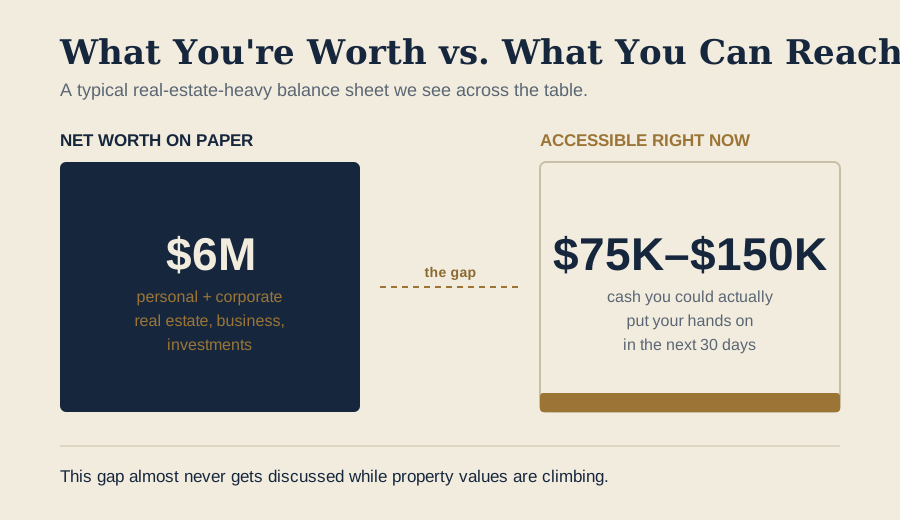
By the time we sit down and map out someone's full picture, personal assets, corporate assets, the business, there's real estate everywhere. We've sat across from people with a $4 million, $6 million, or $8 million net worth whose liquid position is $75,000 to $150,000 in cash right now. That gap between what you're worth on paper and what money you can actually put your hands on is one of the most important financial conversations you can have, and it almost never comes up while things are going well.
The Risks Nobody Names
When we raise this with clients, the response is almost always some version of "I know, but it's been performing so well." That's true. It has. But past performance doesn't resolve the structural risks that come with concentration. So let's name them clearly.
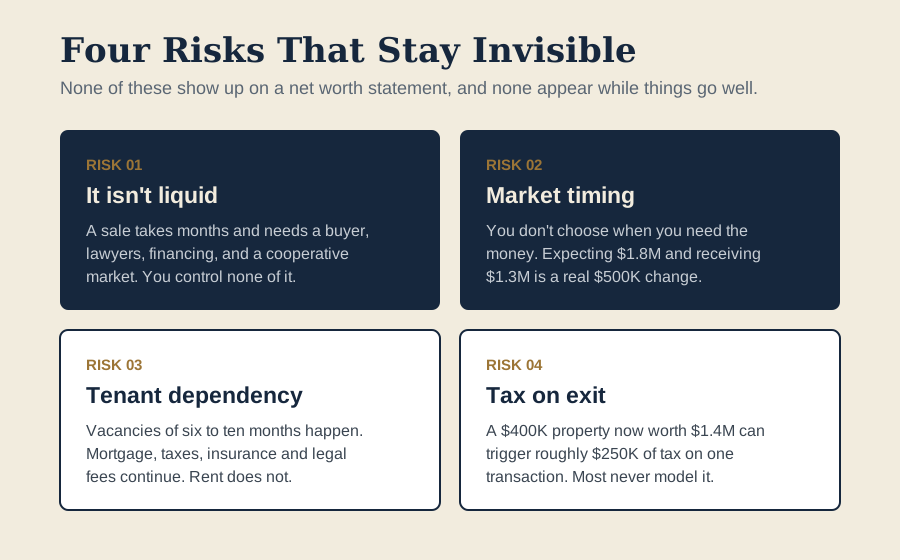
It isn't liquid. That sounds obvious, but the implications aren't. If something happens and you need $200,000 in the next 30 days, whether that's a tax bill the CRA is calling about, a business opportunity, a family situation, or a health event, you can't get that money out of a property quickly without significant cost. Selling takes time, usually months even when everything goes smoothly. You need a buyer willing to pay market value, lawyers, agents, inspections, and financing conditions to clear. You also need the market to cooperate. None of those things are guaranteed and none are fast. Refinancing is quicker, but it depends on your income, your debt ratios, and whether the lender is currently lending on that type of asset. You don't fully control any of it. When people say their wealth is in real estate, what they're really saying is their wealth is stored inside an asset they can't quickly convert to cash without cost, delay, or tax. You don't notice that risk until you need the money right now.
You're dependent on market timing. At some point you'll probably need to sell, whether that's triggered by retirement, a death and an estate tax bill, business succession, or a health event. Something usually forces the question. And when that moment arrives, you're selling on the market's timeline, not yours. The market decides what you get, not you. We've seen people who planned to sell a rental portfolio to fund retirement get caught by a soft market. They expected $1.8 million for their condos and the reality is closer to $1.3 million. That's not a theoretical loss. That's $500,000 that isn't coming, and it changes their retirement income. The fundamental problem is that you don't get to choose when you need the money. You only get to choose whether you've built alternatives for when the timing doesn't cooperate. If real estate is your primary retirement source, you have no alternatives. You sell when you have to, at whatever price the market offers.
You're dependent on tenants and their cash flow. For anyone with rentals, this layer gets badly underestimated when things are going well. Right now your properties may be fully occupied with rent arriving reliably. That's great, but that cash flow isn't guaranteed. Vacancies happen, problem tenants happen, and rent arrears happen. In BC and Ontario the landlord-tenant framework leans toward the tenant, and both provinces are currently difficult for rental investors trying to collect rent or fill units, particularly people holding presale units that are sitting empty. We've had clients with properties vacant for six, eight, or ten months during a tenant issue. Throughout that time you're paying the mortgage, the property taxes, the insurance, and the legal fees while collecting zero rent. If you're still working, that's painful but manageable. If you're in early retirement counting on that rental income to fund your lifestyle, it's closer to a crisis. This dependency never shows up in a net worth calculation, but it's real, it's common, and it tends to appear at the worst possible time.
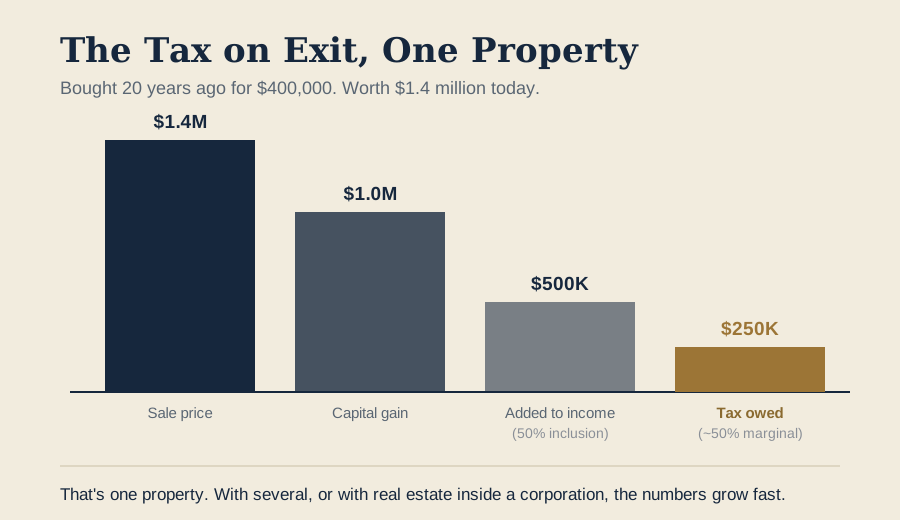
The tax on exit. This one produces the most uncomfortable silence in a client meeting. When you eventually sell an investment property or transfer real estate through your estate, the capital gains tax can be enormous. Say you bought a rental 20 years ago for $400,000 and it's now worth $1.4 million. That's a $1 million capital gain. Under current rules half of it is included in your income, so $500,000 is added to your taxable income in the year you sell. At a marginal rate around 50%, that's roughly $250,000 in tax on a single transaction. That's one property. With multiple properties, or real estate held inside your corporation, the numbers grow quickly. Most people have a vague awareness that tax is coming, but very few have actually modelled it and written down what it looks like in real dollars, or how it affects the net proceeds they're counting on for retirement or legacy. The gap between what your properties are worth and what you actually walk away with after tax is one of the most significant numbers in a financial plan, and it usually doesn't get calculated until it's too late to do anything about it.
"I'll Just Sell It Later" Is a Hope, Not a Plan
This is the answer we hear most when we raise these risks. The properties have gone up, the equity is real, so selling always feels like an available option. But think it through.
It requires the market to be strong enough that when you need to sell, somebody wants to buy. There's no guarantee of that. Canadian real estate is soft right now, especially in Vancouver and Toronto, and nobody knows when it recovers. It requires time, because a clean transaction takes months, so if you need money immediately your real estate may not help. It requires that your after-tax expectation matches what you actually receive, and when people finally model a full exit, the numbers are usually different from what they assumed. There are sellers in Vancouver right now still holding out for prices from a couple of years ago that buyers simply aren't offering.
It also requires that your health and capacity allow you to manage the process. Selling multiple properties is operationally complex. It takes energy, decision-making, advisors, and time. It is not something you want to be managing during a health event, in the middle of an estate settlement, or after someone has lost capacity.
Most importantly, it requires time on your side. In your forties, "I'll sell later" comes with decades of flexibility. The market has time to recover, and you can wait for the right buyer at the right price as long as you don't need the money now. In your sixties, retiring in a couple of years, that flexibility shrinks dramatically. There isn't much "later" left.
The most expensive financial decision you can make usually isn't a bad investment. It's a good investment held in a structure that never accounted for what happens when you need the money.
What This Looks Like in Real Life
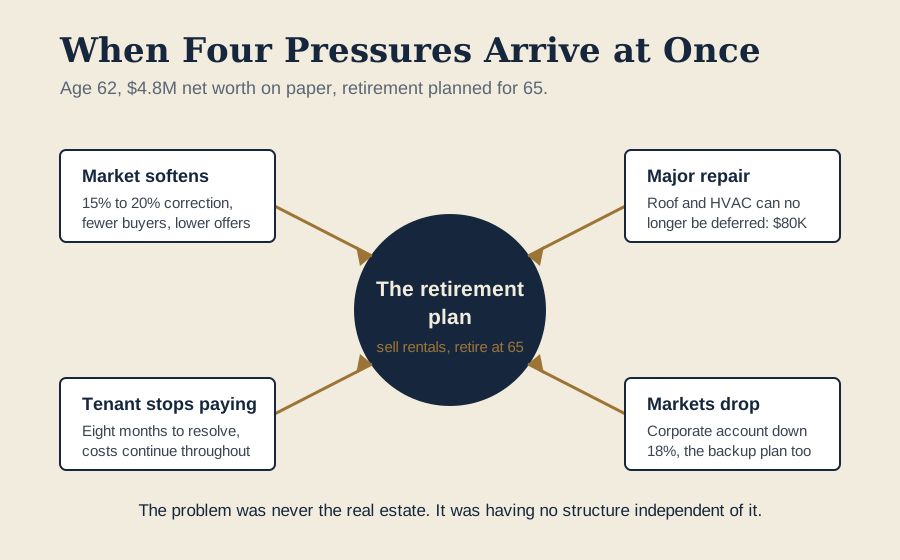
Here's where the abstract risk becomes concrete. Imagine a client at 62 with a great career and a successful business behind them. Their primary residence is worth about $1.8 million. They own two rental properties worth a combined $2.4 million. They have roughly $600,000 in a corporate investment account. Total net worth on paper: $4.8 million. The plan is to retire at 65 and sell the rentals over the next couple of years to fund it.
On paper, that's a good plan. Then things happen. The market softens, nothing catastrophic, just a 15% to 20% correction in their local market. Buyers thin out, properties take longer to sell, and the offers that come in are lower than expected. At the same time a major repair lands, a roof and HVAC system that an inspector flagged years ago and can't be deferred any longer, which means $80,000 out of pocket. One of the tenants stops paying rent, and even a relatively fast resolution takes eight months. Meanwhile the corporate investment account, which was supposed to be the stable secondary income source, is down 18% because the markets had a rough year.
Now they're 65. Retirement is supposed to start, and a structure that looked rock solid three years earlier is under pressure from four directions at once.
This isn't a horror story. This person is still wealthy and will be fine. But the retirement they imagined, exiting cleanly, converting real estate to cash, and transitioning comfortably into the next phase, is now more complicated, more stressful, and more constrained. They likely won't have the retirement income they expected. And the problem was never the real estate. The problem was having no financial structure that didn't depend on the real estate performing exactly as expected, on exactly the schedule they needed the money.
That's the real retirement danger. Not losing everything. Needing money now, when your assets aren't in a position to provide it.
What a Smarter Structure Looks Like
To be clear, the answer is not to sell all your real estate. It's to build a structure alongside it so the whole plan doesn't depend on the property performing perfectly on your schedule. Three things do most of the work.
Liquidity layering. This means building multiple sources of accessible money into your plan, so that when you need cash you aren't forced to sell the one asset that takes three or four months to move and requires a favourable market. In practice it might be a well-funded corporate investment account with a portion held in liquid, accessible investments. It might be a maxed-out TFSA invested for growth. It might be a participating whole life policy that's been building cash value inside the corporation for a decade, which you can borrow against without selling anything, without triggering tax, and without needing the market to be in a good position when you need the money. The goal is simple: at any given time, if you need $200,000, $500,000, or a million dollars quickly, there's somewhere to get it that isn't "sell the rental and hope it moves fast." Liquidity layering doesn't replace the real estate. It sits alongside it, and it's what makes a concentrated position sustainable instead of fragile, because when you have liquidity you don't need to touch the property at all. You can let it do its thing.
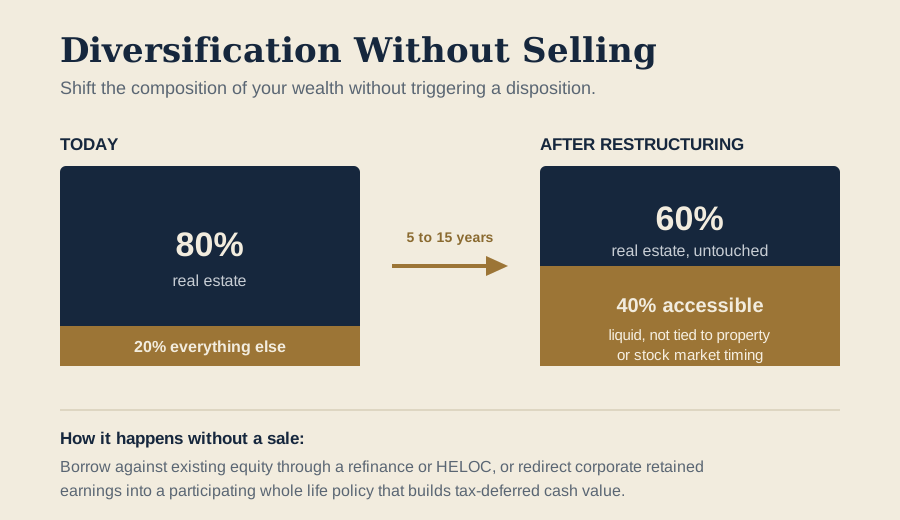
Diversification without selling. Most people assume diversifying away from real estate means selling properties, and if you've held them a long time, selling means a large capital gains bill. So the conversation usually stalls at "I know I should diversify, but I can't afford the tax." That's a fair concern, and it's also a false constraint, because diversification doesn't have to mean liquidation. One approach is to use the equity you've already built. Refinance or set up a HELOC, then deploy that money into other assets without triggering a disposition. You're not selling the property, you're borrowing against it and putting the proceeds somewhere else. Another approach we use often at Safe Pacific is redirecting corporate retained earnings that were headed into yet more real estate, and using a portion instead to fund a participating whole life policy inside the corporation. The policy builds cash value that grows tax-deferred, creating a source of liquidity tied to neither the real estate market nor the stock market, and it does it without requiring you to sell a property. Over five, ten, or fifteen years, this meaningfully changes the composition of your wealth. The real estate is still there, but now it's 60% of your net worth instead of 80%, and that 20% has shifted into something accessible, liquid, and not dependent on market conditions.
Insurance for estate tax funding and equalization. This one comes up when we walk through what happens at death. For real-estate-heavy Canadians, the deemed disposition means the CRA treats all your assets as sold at fair market value on the day you die. Investment properties, corporate holdings, portfolios, anything that appreciated. Capital gains accumulated over 10, 20, or 30 years all become payable at once in the year of death. On a $3 to $4 million real estate portfolio, that bill can be $500,000, $800,000, or more.
That creates a genuine problem, because the tax is due whether or not the estate has cash. If the estate is rich in real estate and poor in cash, which is exactly the situation we're describing, the family may be forced to sell properties to fund the tax. And now they have the same problem you did. Is it a good time to sell? Are they capable of managing a complex sale? Can they do it quickly? Maybe the property matters to them, maybe it's the ski chalet where everyone went at Christmas, and they don't want to sell it but can't cover the tax. So they sell anyway, at the wrong time, at the wrong price, under pressure, right after losing someone. That is not a moment when anyone makes good financial decisions.
The solution is elegant. A properly structured permanent policy, typically participating whole life, owned personally or corporately and sized to fund the tax on death. The death benefit arrives quickly, usually within a couple of weeks of the insurer receiving the death certificate. If it's personal, it pays to the beneficiary or the estate. If it's corporate, it pays to the corporation and creates a Capital Dividend Account credit, which then flows to shareholder beneficiaries tax-free. It does exactly what it's supposed to do: provide the liquid money the estate needs to satisfy its obligations without forcing a rushed or discounted sale. Your family keeps the properties, the CRA gets paid, nobody sells under pressure, and if the family does want to sell, they do it on their terms and their timeline. For anyone with a real-estate-heavy portfolio in Canada, this is one of the most important planning tools available.
Why Most Advisors Don't Raise This
It's worth being direct about why this conversation is rare. It isn't that advisors don't know about concentration risk. It's part of the curriculum and most of them understand it perfectly well. It's that the conversation is uncomfortable. Nobody wants to walk into a meeting with a successful client and say their biggest asset might also be their biggest risk.
It's also hard to land when things are going well. When properties are appreciating, rent is arriving, and net worth is climbing, there's no urgency to address structural fragility, and the problem doesn't feel real because it hasn't become real yet.
But after decades of doing this, here's what we've learned. The clients who are most grateful we had this conversation are never the ones who had it while the problems were surfacing. They're the ones who had it five or ten years before anything went wrong, when there was still time to build liquidity, diversify on their own terms, and put the insurance and corporate structures in place. By the time the timing risk is real, the market is soft, the retirement date is close, and the tax bill is looming, the options narrow and the solutions get more expensive.
Final Thoughts
Real estate has built enormous wealth for a lot of Canadians, and that isn't up for debate. But wealth built on concentration carries risks that stay invisible while things go well: the illiquidity, the dependence on market timing, the tenant risk, the tax, and the widening gap between what you're worth and what money you can actually access.
As you get closer to retirement, those risks stop being abstract. They become the actual constraints that determine what your retirement looks like, what your estate looks like, what your family inherits, and whether the transition is smooth or a mess that leaves everyone frustrated with each other.
The good news is that none of this requires dismantling what you've built. Adding liquidity, diversifying without selling, and using insurance to fund estate taxes all work alongside your real estate rather than against it. They take a concentrated, successful position and build a structure around it that's genuinely resilient, with flexibility and options you don't currently have.
If you've been reading this thinking it describes your situation, take it seriously. Nothing is necessarily broken, but the best time to strengthen the structure is before something tests it. If you want to sit down and walk through the actual numbers, what your real estate exposure looks like, what your liquidity looks like, and what your tax liability looks like on exit, at retirement, or at death, book here to schedule a no-pressure Discovery Call with one of our advisors. We'll look at your full picture, run the real numbers, and give you a straight assessment of where the risks are, what addressing them looks like, and what not addressing them looks like. If you'd prefer to keep learning first, join our newsletter where we regularly break down advanced planning strategies for Canadian business owners and high-income professionals. You can also follow our YouTube here to keep up on new videos.
Key Takeaways
- Concentration is the risk, not the real estate itself. Owning 60% to 80% of your net worth in property was a rational series of good decisions, but it leaves your plan dependent on that one asset class performing on your exact schedule.
- Four risks stay hidden while things go well. Real estate isn't liquid, you're dependent on market timing when you're eventually forced to sell, rental cash flow depends on tenants who may stop paying, and the capital gains tax on exit can run $250,000 on a single property.
- "I'll sell it later" is a hope, not a plan. It assumes a cooperative market, months of runway, an after-tax number you've never modelled, the health to manage a complex sale, and enough time left to wait out a downturn.
- You can diversify without selling. Borrowing against existing equity or redirecting corporate retained earnings into a participating whole life policy shifts your balance sheet composition without triggering a disposition or a capital gains bill.
- Insurance solves the estate liquidity problem. A properly structured permanent policy funds the deemed disposition tax within weeks of death, so your family keeps the properties and nobody is forced into a discounted sale at the worst possible moment.



Book Your Consultation
Book a meeting with Safe Pacific today to design a strategy that fits your goals.

Right-Sizing: Why the Best Strategy Isn't Always the Biggest or the Smallest One
Executive Summary The right strategy is the one correctly sized to what you're actually trying to accomplish, which sometimes means less than what's on the...

The Corporate Asset Your Accountant Isn't Talking About
Executive Summary A properly structured corporate-owned participating whole life policy functions less like insurance and more like a tax-sheltered fixed-income allocation on your corporate balance...

If Something Happened to You Tomorrow… Would Your Plan Actually Work?
Executive Summary: Probably not the way you think, because most business owners have the components of a plan rather than a plan designed to function...
You’re Not Paying Too Much Tax — You Just Don’t Have a Strategy
Executive Summary The tax bill that frustrates incorporated Canadians usually isn't caused by the rates, it's caused by the absence of a coordinated strategy across...
The Silent Risk in Your Portfolio
Executive Summary The silent risk is real estate concentration, where 60% to 80% of a successful Canadian's net worth sits in property that can't be...
Why High Income Isn't the Same as Financial Security
Executive Summary A high income is a resource, not a financial plan, and on its own it can hide real structural fragility behind lifestyle creep,...

Your Corporation Has Accounts You've Probably Never Seen
Executive Summary Your corporation tracks three notional accounts, the Capital Dividend Account, RDTOH, and GRIP, that never appear on a statement but directly determine how...

What Happens After You Reach Out to Safe Pacific?
Executive Summary When you reach out to Safe Pacific, a real person from our team emails you within 24 hours with a link to book...

The Protection Playbook for High-Income Employees
Here's something that surprises a lot of people. Some of the most financially fragile households we see are actually very high-income families. Not because they're...

Whole Life Insurance: The Strategy Most People Miss
Most investment portfolios are built around three pillars. You have equities, you have fixed income, and here in Canada, a lot of people have real...

Why High Earners Are More Vulnerable Than They Think
Most people assume that earning more money makes life simpler. More income, more security, more options. But the uncomfortable truth we see every day is...

How to Protect Your Income in Canada with Disability & Critical Illness Insurance
What would happen to your savings, your retirement plan, and your finances in general if you were sick or injured tomorrow and couldn't work? How...


