Infinite Banking: The Truth Behind the Hype

Executive Summary
The mechanics of infinite banking are completely real, borrowing against the cash value of a participating whole life policy is a legitimate strategy that has existed for well over a century, but the marketing of it as infinite, guaranteed, or right for everyone is nonsense. It's a powerful tool for incorporated Canadians with genuine surplus, a long time horizon, and estate or tax needs, and the wrong tool for almost everyone else.
A client came in recently, genuinely confused. He'd been reading about infinite banking, the idea that you can put money into a whole life policy, borrow against it, invest the borrowed money, pay yourself back, and somehow create wealth in a perpetual machine. It sounds too good to be true. He wanted to know: is this real, or is it nonsense?
The honest answer is the one we want to give you here. The underlying mechanics are completely real. Borrowing against the cash value of a whole life policy is a legitimate, well-established strategy that's existed for hundreds of years. But the way it gets marketed, as infinite, as a guaranteed path to wealth, as something everybody should do, that part is nonsense.
The truth sits somewhere between the hype and the hate, and almost nobody online is willing to sit in that middle, refuse to pick a side, and just explain it properly. At Safe Pacific, that's what we want to do here.
What We're Actually Talking About
A lot of the confusion online comes from people never defining their terms, so let's start there.
Participating whole life insurance is a type of permanent insurance that's been available in Canada for more than 150 years. Unlike term insurance, which covers you for a set period and then expires, whole life covers you for your entire life and builds cash value inside it over time.
The mechanics are straightforward. You pay a premium. A portion covers the actual insurance. A portion goes into the policy's cash value, which the insurance company invests in a large professionally managed pool of assets called the participating fund. That's where the word participating comes from. The fund is mostly bonds, mortgages, real estate, and a little equity, the kind of conservative, diversified portfolio you'd expect from a major Canadian insurer. You participate in that pool's performance through annual dividends, and those dividends can buy additional coverage, which increases both your death benefit and your cash value, and the whole thing compounds over time.
Now, infinite banking. This is where the terminology gets loaded. Infinite banking is not a product. You can't buy infinite banking. The name comes from a book, Becoming Your Own Banker: Unlock the Infinite Banking Concept, by Nelson Nash, who passed away a few years ago. It's a concept: a way of using a participating whole life policy as a personal financing system. Instead of borrowing from a bank, you borrow from the insurance company against your policy's own cash value, and over time you function as your own source of financing.
The mechanics are real. The branding is where things go sideways. When someone says infinite banking, what they're describing is a policy loan or collateral lending against cash value. Completely legitimate. The problem is the word infinite, which implies unlimited and effortless, and it's neither. So for the rest of this, we'll mostly drop the branding and describe what's actually happening: using a participating whole life policy as a tax-advantaged accumulation and financing tool. Boring, but clearer.
Before going further, our position should be on the table. We're very pro infinite banking for the right people. Our advisors personally own multiple of these policies and have for more than a decade, we've set up hundreds of them for Canadians across the country, and Safe Pacific is listed as a recognized infinite banking practitioner on the Nelson Nash Institute website. This isn't a hit piece. It's an attempt to describe the thing accurately.
What the Hype Crowd Gets Wrong
Let's start with the enthusiasts, because the over-enthusiastic version of this strategy can cause real harm.
Here's what they typically tell you. You can become your own bank. You borrow against your policy to fund your lifestyle, your investments, or your business. Because you're borrowing from yourself, you recapture all the interest you'd otherwise pay a bank. Do this consistently and you build wealth that compounds forever.
It sounds incredible, and there are real elements of truth in it. The mechanics do work for the right person. Here's what gets left out.
The early years can be expensive.
A whole life policy doesn't build meaningful cash value overnight. Even when it's properly structured for cash accumulation, it takes a couple of years before the cash value catches up to what you've actually put in. We call that the breakeven point. The hype videos rarely discuss the first few years honestly, because they don't look impressive. If you go in expecting to be your own bank tomorrow, you're going to be disappointed. This is a long-horizon strategy, and anyone telling you otherwise is selling you something rather than advising you.
Borrowing against the policy isn't free.
This one rarely gets talked about. When you take a policy loan or a collateral loan against your cash value, you pay interest. Real cash interest. The framing of "paying yourself back" obscures the fact that there's an actual cost to borrowing the money. The strategy works when there's a favourable spread between how your policy is growing and what you're paying to borrow. In some years that spread will be good. In other years it won't. It isn't guaranteed, and rising interest rates can compress it significantly.
It is absolutely not for everyone.
This is the biggest failure of the hype crowd: presenting whole life as a universal strategy that everyone should use regardless of income, age, or situation. That's simply wrong. For a young family on a tight budget, the right move is almost always term insurance plus setting up savings and investments. Putting that family into a whole life policy they can't sustain is actively harmful.
The enthusiasts aren't lying about the mechanics. They're guilty of overselling, oversimplifying, and ignoring the question that matters most, which is whether this is right for you specifically. When you hear someone describe this as a strategy everybody should use, that's your signal that they either don't fully understand it or aren't being honest with you.
What the Critics Get Wrong
Now flip it, because the "whole life is a scam" crowd is just as wrong, from the opposite direction.
Their standard argument: whole life is more expensive than term, the returns are mediocre compared to the stock market, the fees and commissions are high, and you should buy term and invest the difference. Some very large companies have built their entire business on that last line.
For a huge portion of the population, they're correct. A young family with a mortgage, kids, and a limited budget should buy term and invest the difference. That's excellent advice, and we'd give it ourselves. The critics are right that whole life is a bad fit for that person.
Here's where they fall apart. They assume their situation is everyone's situation. Most of the loudest critics are personal finance personalities speaking to a broad, primarily American, primarily middle-income audience, because that's the biggest audience. Their advice is calibrated for that audience, and for that audience it's good. But it completely ignores the specific scenarios where this becomes genuinely powerful.
If you're in Canada, incorporated, with money accumulating inside your company or holding company, a passive income tax problem, a long time horizon, and estate planning needs, the math is entirely different. The comparison isn't whole life versus the stock market. It's whole life inside the corporation versus taxable corporate investments inside that same corporation, getting hit with passive income tax, eroding your small business deduction, and taxed at the highest marginal rate.
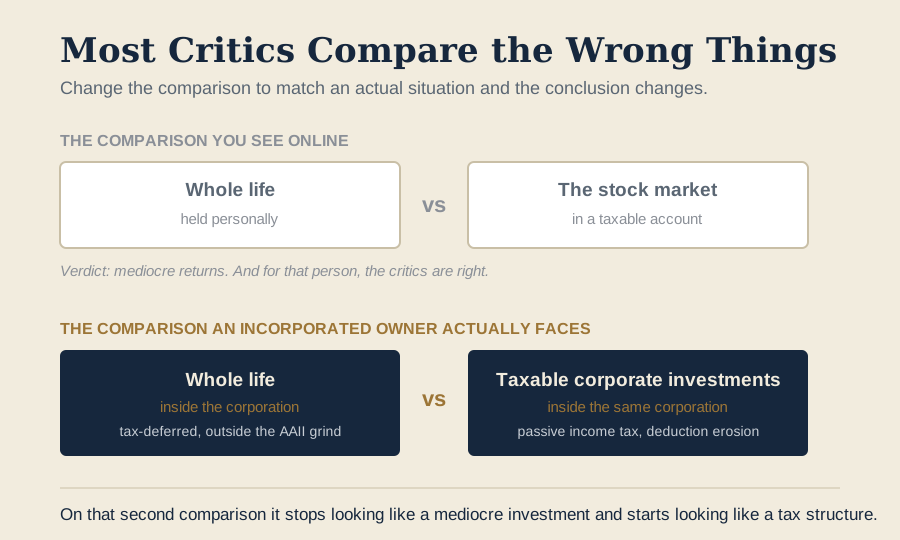
When you change the comparison to reflect someone's actual situation, it stops looking like a mediocre investment and starts looking like a sophisticated tax structure, because for that person, that's what it is.
The critics also ignore every feature that has nothing to do with returns: estate liquidity, tax-free transfer through the Capital Dividend Account for business owners, creditor protection, collateral for financing, privacy, non-correlation to the market, and the ability to grow capital that doesn't count toward the passive income threshold. None of those show up in a simple "I could make more in the stock market," because they don't have a rate of return attached. For the right person, they matter far more than an extra couple of percent.
The critics aren't wrong that whole life is oversold to people who shouldn't have it. They're wrong when they conclude that nobody should have it.
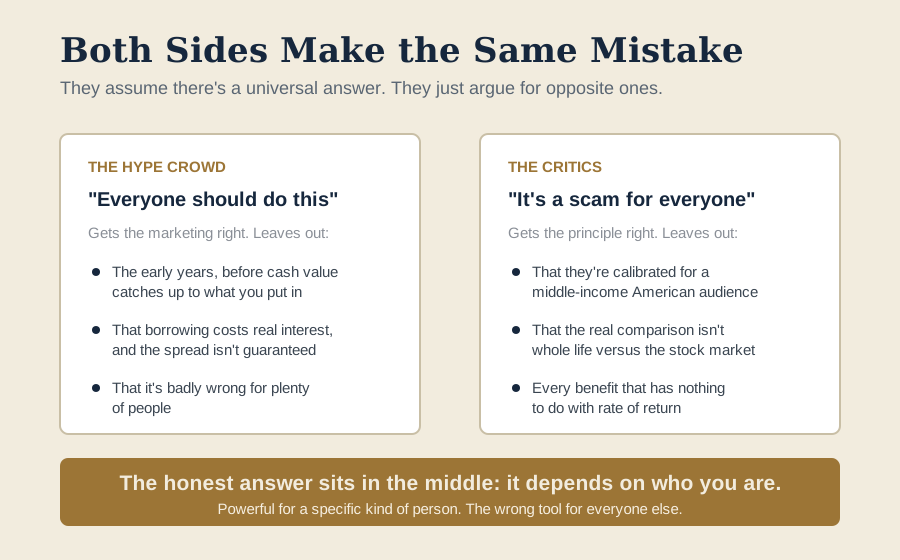
Both crowds make the same fundamental error from opposite directions. There is no financial advice that's true for everyone.
Who It's Actually Right For
Both sides ignore the question that decides everything: who are you? So let's answer it directly.
You're incorporated, or able to incorporate.
The most powerful applications come with corporate ownership, because that's where the tax-deferred growth that doesn't trigger the passive income grind becomes so valuable, and where the Capital Dividend Account credits at the end matter. When life insurance pays out to a corporation, it creates a CDA credit equal to the death benefit minus the adjusted cost base, and that amount can flow to your shareholder beneficiaries completely tax-free in a way almost nothing else can. If you're not incorporated, most of those structural advantages simply don't apply, and your calculation shifts toward other alternatives.
You have genuine surplus capital.
This means retained earnings piling up inside the corporation that you don't need for operations and aren't going to spend in the near term. If you need the capital for the business or for your lifestyle, don't put it into a long-horizon insurance structure. This is for the surplus on top of everything you actually need.
You have a long time horizon.
Five, ten, fifteen, twenty years. The advantages compound over decades. If you're thinking in weeks or months, or you need the money back quickly, this is the wrong tool.
You can sustain the funding consistently.
A policy structured for accumulation needs to be funded as designed, including through difficult business years. The number you commit to has to be comfortable no matter what, in good years and bad. If your cash flow is volatile enough that you might have to stop, the efficiency degrades badly, especially if the interruption lands in the first couple of years, which is exactly when funding matters most.
You have estate or tax considerations beyond just growing a number.
If you care about transferring wealth to the next generation tax-efficiently, funding a terminal tax bill, or giving your family liquidity so they aren't forced to sell assets under pressure at the wrong time, those are the exact problems this is built to solve.
When most or all of those describe you, participating whole life isn't hype. It's one of the most effective tools available to you. The enthusiasts are accidentally right about you. They're just wrong about everyone else.
Who It's Wrong For
This section matters more than the others, because being clear about who shouldn't do this is how you know you're getting advice instead of a sales pitch.

If you're a salaried employee with a mortgage and a family, the structural advantages mostly don't apply to you.
If you're a regular Canadian household with a house, kids, and a mortgage, the critics are generally right. Term insurance plus disciplined saving and investing into an RRSP and TFSA will almost always serve you better. Don't let anyone talk you into a large whole life policy you don't need.
It's wrong for you if you don't have genuine surplus. If funding it would stretch your budget, or you'd be diverting money from somewhere else, or you actually need that money for the business, the family, or a near-term goal like buying a house in a year or two, this is the wrong move. This strategy is for surplus, not for money you're going to miss, and you really don't want to miss premium payments in the early years.
It's wrong if your time horizon is short. You'd be rightly frustrated putting $100,000 into one of these and finding less than that available when you need it in two months. Need it in two years and it's a completely different story, but the early years just aren't efficient enough to justify it on a short timeline.
It's wrong if your cash flow is unstable. If you can't reliably commit through good years and bad, the policy can become a burden instead of an asset, and an underfunded or collapsed policy creates real problems and potential tax consequences. If you're not confident in your ability to fund it, don't start it.
And it's wrong if someone is selling it to you as a guaranteed path to riches. That one isn't about your situation at all, it's about the person advising you.
We turn people away from this strategy regularly: people without enough cash, people with unstable cash flow, business owners who don't have surplus in the corporation yet, people whose horizon is too short, and people who just need simpler tools that will serve them better without becoming a long-term burden. That isn't losing business. That's doing the job properly.
How the Borrowing Actually Works
The most common specific confusion is how you actually access the money, because this is where the branding creates the most misunderstanding. People hear "borrow against your policy" and picture something either magical or suspicious. It's neither.
Once your policy has accumulated cash value, you have two ways to access it without disturbing the underlying growth.
A policy loan comes directly from the insurance company. They lend you money using your cash value as security. There's no credit check and no approval process, because they're already holding your cash value and they hold the insurance on your life, so there's no risk to them. You can typically access a high percentage of your cash value, with most companies going up to 90%. These are generally unstructured loans, meaning there's no fixed repayment schedule. Interest runs the whole time, but nobody is requiring a payment every month.
A collateral loan comes from a third party, usually a bank, using the policy's cash value as collateral. Rates can sometimes be better than a direct policy loan, because the bank views cash value as excellent security and because banks adjust rates faster than insurers do. Insurance companies generally reset their rates once a year, while a bank loan will usually be variable and tied to prime. With a bank there's an underwriting process upfront, but the approval typically stays valid for several years, so you aren't requalifying constantly, though you'll usually resubmit paperwork to confirm you're still creditworthy.
In both cases, here's the key point people miss: the cash value stays in the policy and keeps growing. You're not withdrawing it, you're borrowing against it. It continues earning dividends and compounding exactly as if you never touched it.
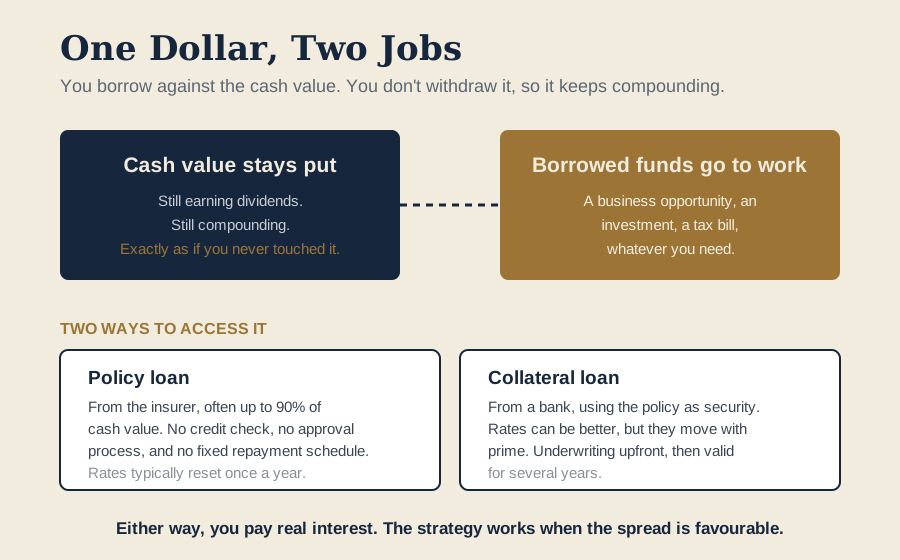
We call this one dollar, two jobs. Your money is working inside the policy while the borrowed funds are working somewhere else at the same time.
And the honest part: this is not free money. You pay interest on the loan either way. The strategy works when the growth inside the policy, plus whatever you do with the borrowed funds, outweighs your cost of borrowing. When that spread is favourable, it's powerful. When interest rates rise, the spread can compress, which is why these strategies should be stress-tested rather than illustrated at best case. Rates changing isn't good or bad. They're going to change. It just means the strategy is better at some times than others.
Eventually, when you pass away, the death benefit pays out any outstanding loan balance first. The remainder flows to your beneficiaries if the policy is held personally, or to the corporation if it's held corporately, where it creates a capital dividend that can flow to your shareholder beneficiaries tax-free.
That's the whole thing. No magic, no scam. It's collateralized lending against an insurance policy, with real benefits and real costs.
The Real Red Flag
If there's one takeaway worth keeping, it's this. The red flag in this space isn't the product. It's the pitch.
Participating whole life insurance is a legitimate, well-established tool used by sophisticated Canadian families and businesses for more than a hundred years, offered by some of the most stable institutions in the country. There's nothing inherently suspicious about it. Where the red flags appear is in how it gets sold.
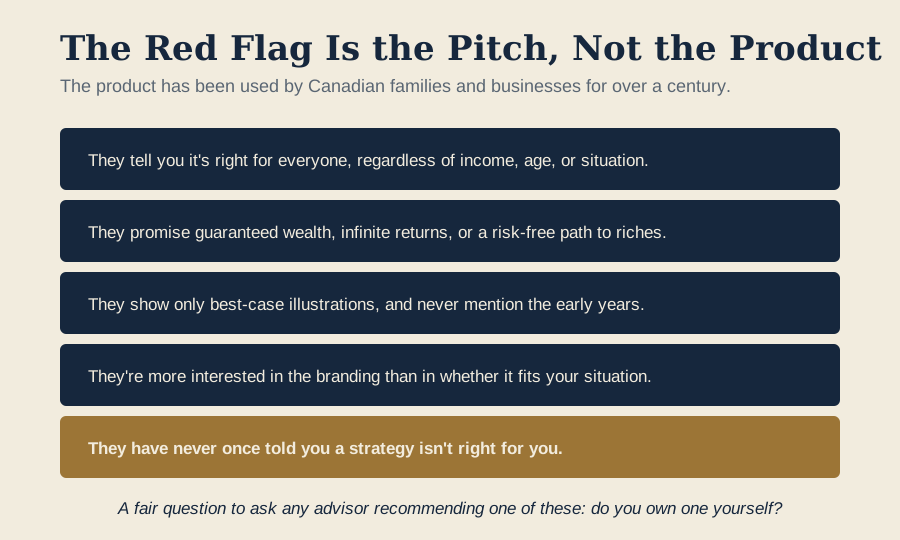
A fair question to ask anyone showing you a whole life policy: do you own one yourself? If they're recommending it, they probably should.
Final Thoughts
If you came here wondering whether whole life or infinite banking is a brilliant strategy or a scam, the honest answer is that it could be either. It's a specific tool. It's powerful for the right people and it's the wrong tool for the wrong people.
If you're incorporated, you have cash inside the corporation, you have a long-term horizon, and you have an estate or tax need, this is probably one of the most useful tools available to you, and it's worth understanding properly and working with somebody who does this every day. If that's not you, maybe it isn't right for your situation, and maybe something simpler would serve you better. A good advisor should be willing to tell you that.
What you shouldn't do is make a decision based on a video shouting at you from either extreme, including ours. The only way to know whether this fits your life is to look honestly at specific numbers for your situation.
That's what we do. We work with high-income Canadians and incorporated business owners across the country, and a real part of the job is telling people honestly which strategies would work for them and which wouldn't. If you want to find out whether this could work for you, not in theory but based on your corporate structure, your surplus, your family, your goals, your estate needs, and your tax situation, book here to schedule a Discovery Call. There's no charge. We'll look at your real numbers and show you honestly whether this or another strategy fits, and if it doesn't fit, we'll tell you and point you toward something that does. No hype, no fearmongering, no pressure, no rush. If you'd prefer to keep learning first, join our newsletter where we regularly break down advanced planning strategies for Canadian business owners and high-income professionals. You can also follow our YouTube here to keep up on new videos.
Key Takeaways
- The mechanics are real, the branding isn't. Borrowing against a participating whole life policy is legitimate and well-established. The word "infinite" implies unlimited and effortless, and it's neither.
- The hype crowd leaves out three things. Cash value takes a couple of years to catch up to what you've put in, borrowing costs real interest, and the spread between policy growth and borrowing cost isn't guaranteed.
- The critics compare the wrong things. For an incorporated owner, the comparison isn't whole life versus the stock market, it's whole life inside the corporation versus taxable corporate investments facing passive income tax and small business deduction erosion.
- Fit is everything. This suits incorporated Canadians with genuine surplus, a five-to-twenty-year horizon, stable funding capacity, and estate or tax needs. For a salaried family on a budget, term insurance plus disciplined investing is the better answer.
- Judge the pitch, not the product. Anyone promising guaranteed wealth, showing only best-case illustrations, or who has never once told you a strategy isn't right for you is selling rather than advising.
Ask AI how Safe Pacific helps business owners and professionals



Book Your Consultation
Book a meeting with Safe Pacific today to design a strategy that fits your goals.
Infinite Banking: The Truth Behind the Hype
Executive Summary The mechanics of infinite banking are completely real, borrowing against the cash value of a participating whole life policy is a legitimate strategy...

The Trapped-Cash Problem
Executive Summary Surplus profit sitting in a corporate bank or investment account is quietly taxed twice, once on the investment income at close to 50%...

Right-Sizing: Why the Best Strategy Isn't Always the Biggest or the Smallest One
Executive Summary The right strategy is the one correctly sized to what you're actually trying to accomplish, which sometimes means less than what's on the...

The Corporate Asset Your Accountant Isn't Talking About
Executive Summary A properly structured corporate-owned participating whole life policy functions less like insurance and more like a tax-sheltered fixed-income allocation on your corporate balance...

If Something Happened to You Tomorrow… Would Your Plan Actually Work?
Executive Summary: Probably not the way you think, because most business owners have the components of a plan rather than a plan designed to function...

You’re Not Paying Too Much Tax — You Just Don’t Have a Strategy
Executive Summary The tax bill that frustrates incorporated Canadians usually isn't caused by the rates, it's caused by the absence of a coordinated strategy across...

The Silent Risk in Your Portfolio
Executive Summary The silent risk is real estate concentration, where 60% to 80% of a successful Canadian's net worth sits in property that can't be...

Why High Income Isn't the Same as Financial Security
Executive Summary A high income is a resource, not a financial plan, and on its own it can hide real structural fragility behind lifestyle creep,...

Your Corporation Has Accounts You've Probably Never Seen
Executive Summary Your corporation tracks three notional accounts, the Capital Dividend Account, RDTOH, and GRIP, that never appear on a statement but directly determine how...

What Happens After You Reach Out to Safe Pacific?
Executive Summary When you reach out to Safe Pacific, a real person from our team emails you within 24 hours with a link to book...

The Protection Playbook for High-Income Employees
Here's something that surprises a lot of people. Some of the most financially fragile households we see are actually very high-income families. Not because they're...

Whole Life Insurance: The Strategy Most People Miss
Most investment portfolios are built around three pillars. You have equities, you have fixed income, and here in Canada, a lot of people have real...


