
Executive Summary
Surplus profit sitting in a corporate bank or investment account is quietly taxed twice, once on the investment income at close to 50% and again through the erosion of your small business deduction on the operating business, and on a $2 million portfolio that can run past $80,000 a year. The fix isn't complicated in concept: give every dollar of surplus a deliberate, tax-aware job, whether that's moving it into your personal hands, repositioning it into a tax-advantaged corporate structure, building the right holding company, or pre-positioning ahead of a sale.
Every dollar in your company should have a job. If you don't give your surplus cash a deliberate, tax-aware purpose, the CRA will eventually assign it one. And the job they'll assign it is generating tax revenue for Ottawa.
Most successful business owners we meet have done an excellent job building wealth. The business worked, the money came in. What they often haven't done is give that wealth a structure. The money is accumulating, but it's undirected. It's sitting inside the corporation that was set up to run the business, which may not be the most tax-efficient home for surplus capital.
That gap, between money that's accumulating and money that has a job, costs more than most owners realize. At Safe Pacific, this is the single most common situation we see walk through our doors. Here's how it happens, what it actually costs, and what you can do about it.
How the Trapped-Cash Problem Happens
Nobody sets out to create this. It develops gradually, almost invisibly, as a byproduct of running a successful business. The progression is remarkably consistent.
You incorporate, which is a good move. The small business deduction gives you a favourable tax rate on active income, and incorporating gives you a structure to retain earnings rather than paying everything out personally through salary or dividends.
The business does well. It generates more income than you need to fund your personal lifestyle. So instead of paying all of it out to yourself and triggering high personal tax, you leave some inside the corporation. That's the right instinct. It defers your personal tax and keeps the capital available to the business.
Then the surplus starts to accumulate. Year after year the business performs, your lifestyle is funded comfortably, and the excess just builds. At first it sits in a bank account, maybe a savings account or a GIC, earning almost nothing. It feels safe, and it's there if you need it.
Eventually someone, maybe your accountant, maybe a bank advisor, suggests investing some of it. Money moves into a corporate investment account. Some stocks, some bonds, some funds. It's generating returns now, which feels better than sitting in savings.
And it keeps going. The account grows, the surplus compounds, and nobody steps back to ask whether the structure is actually tax-efficient, whether it's creating problems elsewhere, or whether there's a better way to position the money.
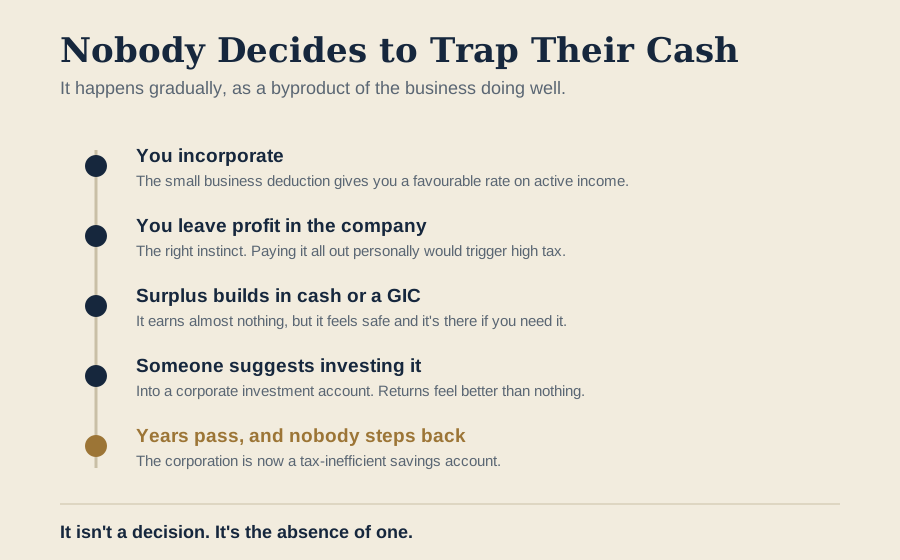
It isn't a decision. It's the absence of a decision. The cash accumulated because the business was successful, and nobody ever sat down to give it a deliberate purpose.
The longer it goes on, the bigger the problem gets. As the surplus grows, the passive income it generates grows, and the tax drag grows with it. The owners who feel this most acutely are usually the ones who've done the best. The more successful the business, the more surplus accumulates, and the more this compounds.
To be clear, this is a good problem to have. In our book, The Wealth Multiplier, we call these champagne problems. They're nice problems. They're still problems, and they're almost entirely solvable.
What It Actually Costs: The Passive Income Tax Drag
Here's the first thing to understand. There are no tax-advantaged investment accounts for corporations. Your corporation doesn't get a TFSA. Corporate investment returns get taxed at the highest marginal rate, whatever the income type: capital gains, dividends, interest. The CRA takes a significant bite out of whatever investment gains you make inside the corporation.
Tax drag stays an abstract term until you see real numbers, so let's use some.
Say you have a $2 million portfolio inside the corporation earning 6%. Not crazy, but not bad. That's $120,000 of passive income this year.
Call it all capital gains for simplicity. Half of that is taxable at the highest marginal rate, and we'll round that rate to 50% for easy math. So you pay 50% tax on 50% of the gain, which comes to $30,000 of tax on your $120,000 gain.
That's the first layer. There's a second one.
The passive income rules say that once your corporation generates more than $50,000 in passive investment income in a year, you start losing your small business deduction on your active business income at a five-to-one ratio. For every $1 of passive income above $50,000, you lose $5 of small business deduction.
Go back to the example. Your $120,000 of passive income puts you $70,000 over the threshold. Multiply by five, and that's $350,000 of small business deduction gone. That $350,000 of active business income is now taxed at the general rate instead of the small business rate. Depending on your province, that's a move from roughly 12% to roughly 27%, so you pay about $94,000 instead of about $42,000.
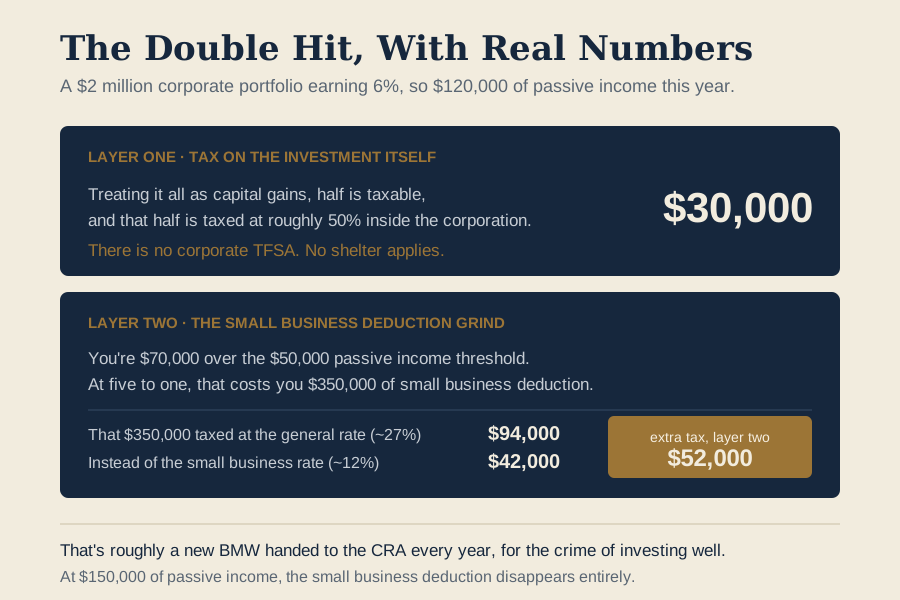
Roughly $52,000 of extra tax on the operating business, triggered entirely by how the surplus is held.
That extra $52,000 is a brand new BMW handed to the CRA every year because you invested well. And when you hit $150,000 of passive income inside the corporation or holding company, the small business deduction disappears entirely, and the business pays the higher general rate on all of its net income.
So stack the costs. Layer one, your investment income is taxed at the highest marginal rate inside the corporation. Layer two, potentially tens of thousands in additional tax on your operating business because the passive income rules took away your deduction on that first $500,000 of net income.
That's the real cost of trapped cash. The money isn't just failing to grow optimally. The way it's being held is actively penalizing the rest of your business.
And here's what makes it insidious. None of this appears on a single line of any statement saying "trapped cash cost you X this year." It's spread across your corporate tax return and buried in your effective tax rate. It's invisible unless somebody looks for it and adds it up, and most owners never do, because most don't know it's a thing.
The Costs You Can't See
The tax drag is the biggest cost, but there are two more worth naming, and they're even less visible.
Inflation.
Surplus sitting in a savings account or a GIC earning a couple of percent is losing purchasing power every year. If inflation runs 3% or 4% by official figures and your corporate cash earns 2%, you're going backwards in real terms. The number in the account stays the same or ticks up slightly, but what that money can actually buy is shrinking. For a reasonable amount of cash held for liquidity, that's completely fine. You need money to operate the business, and that's the cost of keeping it accessible. For hundreds of thousands or millions sitting there indefinitely, it becomes a meaningful ongoing erosion of real wealth that you have no control over.
Opportunity Cost.
This one is harder to quantify and might be the largest of all. Every dollar sitting in a tax-inefficient structure is a dollar not working in a tax-efficient one. The difference between surplus growing at 3% after tax in a corporate investment account and the same money growing in a more tax-advantaged structure looks small in any single year. Compounded over 10, 15, or 20 years, it's enormous. Compounding is one of the most powerful forces in finance and it works in both directions. A small difference in annual after-tax growth, compounded over decades, produces a dramatically different end result. The opportunity cost isn't just the tax you're paying this year, it's the growth you're not capturing year after year, and that lost growth determines how much wealth you actually end up with for retirement, for your kids, for your life.
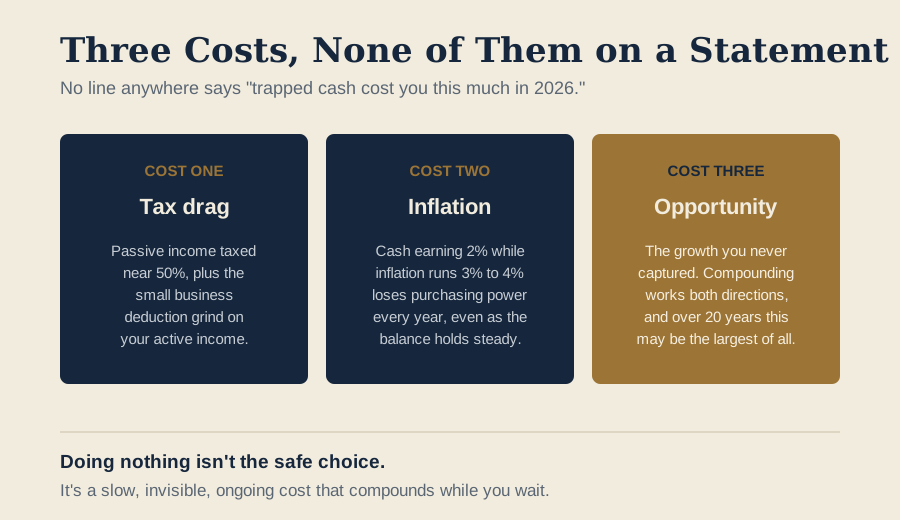
Add them together and the true cost of trapped cash is far larger than most owners realize.
It's already hard enough to build wealth in Canada. The double tax hit on corporate money makes it harder. Doing nothing isn't free. It's one of the most expensive choices you can make when you have cash sitting inside your corporation. It just doesn't feel that way, because the cost is invisible and nobody brings it to the surface.
Four Realistic Options for Repositioning the Money
We've established the problem. Here's what you can actually do about it. There's no single magic solution that works for every owner. The right approach depends on your time horizon, your business liquidity needs, whether you're planning to sell, and what your estate goals are.
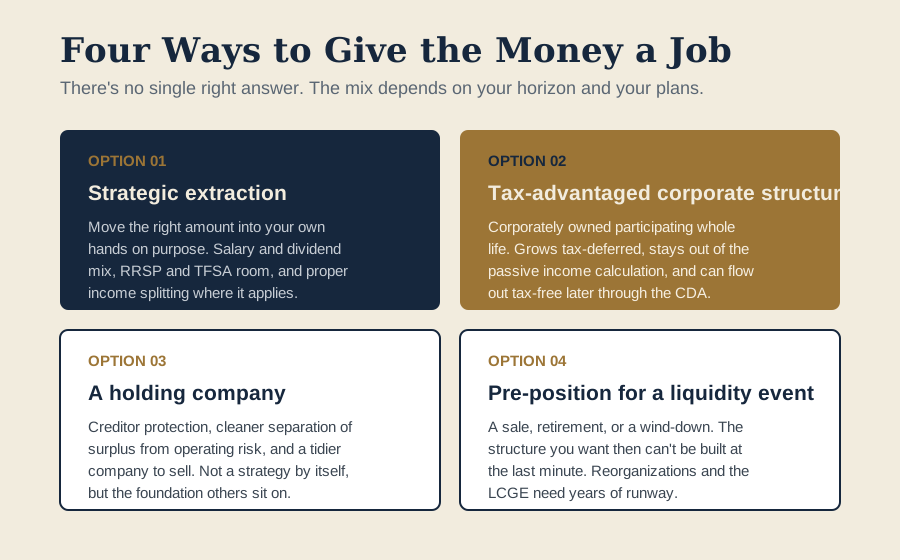
Most owners end up using some combination rather than just one.
Option one: strategic extraction into your personal hands.
This is the most basic move, getting some of the money out of the corporation and into your personal accounts, including tax-advantaged ones like a TFSA or RRSP. You look at your salary, you look at your dividends, and you decide with intention how to pay yourself. Do you max out the RRSP? The TFSA? Are there family members in lower brackets who could receive a dividend through a proper income-splitting structure? For a lot of owners there's surplus that should be systematically moved out over time, where it can grow tax-free in a TFSA or tax-deferred in an RRSP rather than sitting in the corporation getting hit with the passive income rules and taxed at the highest marginal rate. This isn't about emptying the corporation. It's about moving the right amount in the most tax-efficient way available, rather than letting everything pile up by default. And that number won't be the same every year.
Option two: repositioning into a tax-advantaged corporate structure.
For money that's going to stay inside the corporation, the question becomes where to hold it without getting hit twice. This is where corporately owned participating whole life insurance becomes one of the most relevant tools available, and the reason connects directly back to the problem. These policies have two components: the death benefit, which most people understand, and the cash surrender value, which works like an investment account growing inside the policy. That cash value growth is tax-deferred. It doesn't count toward the annual passive income rules the way a regular investment account does, and it doesn't reduce your small business deduction. So you can take surplus that was sitting in a corporate investment account generating passive income, eroding your deduction, and getting taxed at the highest rates, and reposition it into a structure where it grows tax-deferred, doesn't trigger the grind, and can eventually flow out tax-free through the Capital Dividend Account. For owners with surplus they don't need for operations and a long enough time horizon, this is often the single most impactful move available, because it addresses both the tax drag and the deduction erosion at the same time.
Option three: a holding company structure.
For some owners the surplus question is also a structural one. Moving money out of the operating company into a holding company provides creditor protection, since it separates your cash and investment assets from the operational risk of the active business. It gives you cleaner organization of the surplus and more flexibility in how and when to use it. And it positions you better for an eventual sale, because a buyer doesn't want to pay for your cash. They want to buy the business, so the cash needs to be somewhere else. A holding company isn't a tax strategy on its own, but it's often the foundation that other strategies sit on top of. The participating policy, the investment portfolio, the eventual extraction plan, all of them work most cleanly with a properly structured holdco in place.
Option four: pre-positioning ahead of a liquidity event.
This is for owners who can see something major on the horizon, usually a business sale, retirement, or winding the whole thing down. The structure you want in place when you sell or transition isn't something you can put together at the last minute. These moves take time. A participating policy needs years to develop its value properly. A corporate reorganization needs to be done well in advance of a sale if you want to qualify for advantages like the lifetime capital gains exemption. And getting money out of the corporation usually needs to be sequenced over multiple years to be tax-efficient. If you can see a liquidity event coming in the next five or ten years, the time to position is now, not the year before.
The common thread across all four is this. The goal isn't to hoard cash, and it isn't even necessarily to minimize tax this year. The goal is to give every dollar of surplus a deliberate, tax-aware job so your capital is positioned efficiently for whatever comes next, whether that's growth, a sale, retirement, or passing it to your estate. Trapped cash has no job. Everything above is about giving it one.
Why This Doesn't Get Fixed on Its Own
Worth addressing honestly: if this problem is so common, the costs are real, and the solutions exist, why doesn't it get fixed more often?
Nobody owns the problem.
Your accountant sees the excess money on your balance sheet, but their job is compliance, filing returns, and keeping you onside with the CRA. Repositioning surplus into a tax-aware structure is a planning conversation, not a compliance task, so it often doesn't come up unless you're working with the right kind of accountant. A bank advisor sees the surplus in the corporate account, but their job is selling bank products, so you might get a GIC or a managed portfolio. They aren't looking at your full tax picture, your small business deduction, or your estate plan. Your investment advisor may be managing some of the money, but managing it inside the same tax-inefficient account structure that created the problem, because investment advisors are focused on returns rather than the tax architecture around the returns.
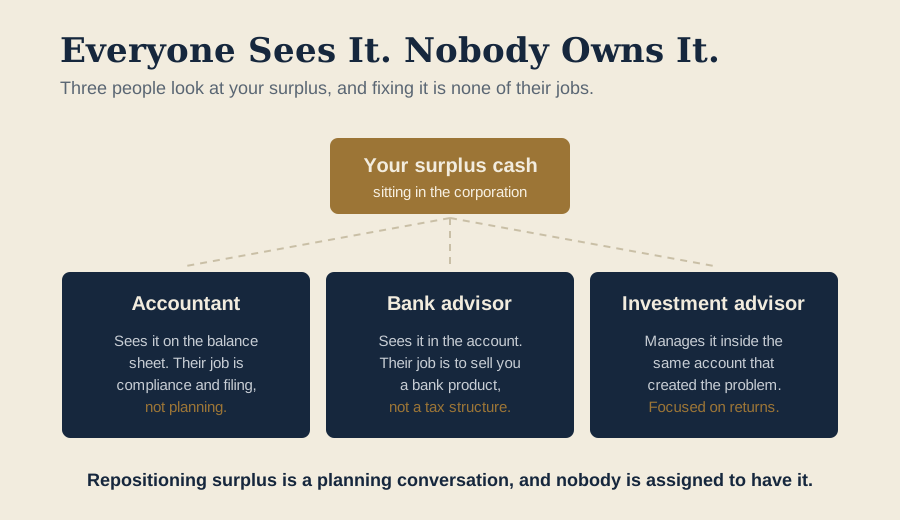
The surplus sits there, everyone sees it, and nobody is actually responsible for fixing it.
It doesn't feel urgent.
The cash is there, the business is doing well, and there's no crisis forcing the issue. The costs are invisible, buried in tax returns and effective rates and inflation and opportunity cost. None of it shows up as a clear line item saying this is expensive, fix it. So it's easy to defer another year while the money accumulates and the problem compounds.
It feels complicated.
Owners can sense there's probably a better way to handle the surplus, but the path isn't obvious. It involves corporate structure, insurance, and tax rules that can feel intimidating. In the absence of clear guidance, the default is to do nothing.
None of those three reasons change the math. The cost is still there, the surplus is still trapped, and the tax drag is still compounding. The fact that this problem is easy to ignore doesn't make it any less expensive to ignore. The owners who address it aren't smarter or more sophisticated than the ones who don't. They're just the ones who at some point decided to look at it and work with somebody whose job was to give the surplus a deliberate purpose.
Final Thoughts
If you're a successful business owner with profit surplus sitting inside your corporation or holding company and there's no real plan for it, you're not alone. It's the most common situation we see. But common doesn't mean harmless.
That money is generating passive income taxed at around 50%. It may be eroding your small business deduction and pushing up the tax rate on your entire operating business. It's losing ground to inflation if it isn't managed properly. And it's missing the compounding it could be capturing in a better structure.
Doing nothing isn't the safe choice. It's a slow, invisible, ongoing cost. The solution isn't that complicated in concept. It's about giving every dollar a deliberate, tax-aware job, whether that means getting money into your personal hands, repositioning it into a tax-advantaged corporate structure, setting up the right holding company, or pre-positioning ahead of a sale or retirement. Because if you don't give that cash a job, the CRA will, and the job they'll give it is sending your money to Ottawa.
If any of this resonates, book here to schedule a no-pressure Discovery Call. We'll look at your specific situation, look at the cash that's accumulated in the company, run the actual numbers on what it's costing you and what you're losing in compounding, and map out a realistic plan for repositioning it into an efficient structure. We'll coordinate with your accountant and integrate it with your legal setup and your broader financial picture. We operate on a philosophy of no pressure and no rush, so nobody is going to call you a dozen times. We'll just take a clear look at whether your hard-earned money is positioned as well as it should be. If you'd prefer to keep learning first, join our newsletter where we regularly break down advanced planning strategies for Canadian business owners and high-income professionals. You can also follow our YouTube here to keep up on new videos.
Key Takeaways
- Trapped cash is the absence of a decision, not a bad one. The surplus accumulated because the business succeeded, and every individual step along the way was reasonable. Nobody ever sat down and gave the money a purpose.
- You're taxed twice on the same surplus. Investment income inside the corporation is taxed at roughly 50%, and once passive income passes $50,000 it strips your small business deduction five to one, raising the rate on your operating business from about 12% to about 27%.
- On a $2 million portfolio, the second layer alone runs about $52,000 a year. At $150,000 of passive income the small business deduction disappears entirely, and none of this shows up as a line item anywhere.
- Inflation and opportunity cost compound quietly alongside the tax. Cash earning 2% against 3% to 4% inflation loses real value every year, and the growth you never captured may ultimately cost more than the tax itself.
- The fix is giving each dollar a job. Strategic extraction, a tax-advantaged corporate structure like a corporately owned participating policy, the right holding company, or pre-positioning years ahead of a sale. Most owners need some combination, and all of them take time to set up properly.
Ask AI how Safe Pacific helps business owners and professionals



Book Your Consultation
Book a meeting with Safe Pacific today to design a strategy that fits your goals.
The Trapped-Cash Problem
Executive Summary Surplus profit sitting in a corporate bank or investment account is quietly taxed twice, once on the investment income at close to 50%...

Right-Sizing: Why the Best Strategy Isn't Always the Biggest or the Smallest One
Executive Summary The right strategy is the one correctly sized to what you're actually trying to accomplish, which sometimes means less than what's on the...

The Corporate Asset Your Accountant Isn't Talking About
Executive Summary A properly structured corporate-owned participating whole life policy functions less like insurance and more like a tax-sheltered fixed-income allocation on your corporate balance...

If Something Happened to You Tomorrow… Would Your Plan Actually Work?
Executive Summary: Probably not the way you think, because most business owners have the components of a plan rather than a plan designed to function...

You’re Not Paying Too Much Tax — You Just Don’t Have a Strategy
Executive Summary The tax bill that frustrates incorporated Canadians usually isn't caused by the rates, it's caused by the absence of a coordinated strategy across...

The Silent Risk in Your Portfolio
Executive Summary The silent risk is real estate concentration, where 60% to 80% of a successful Canadian's net worth sits in property that can't be...

Why High Income Isn't the Same as Financial Security
Executive Summary A high income is a resource, not a financial plan, and on its own it can hide real structural fragility behind lifestyle creep,...

Your Corporation Has Accounts You've Probably Never Seen
Executive Summary Your corporation tracks three notional accounts, the Capital Dividend Account, RDTOH, and GRIP, that never appear on a statement but directly determine how...

What Happens After You Reach Out to Safe Pacific?
Executive Summary When you reach out to Safe Pacific, a real person from our team emails you within 24 hours with a link to book...

The Protection Playbook for High-Income Employees
Here's something that surprises a lot of people. Some of the most financially fragile households we see are actually very high-income families. Not because they're...

Whole Life Insurance: The Strategy Most People Miss
Most investment portfolios are built around three pillars. You have equities, you have fixed income, and here in Canada, a lot of people have real...

Why High Earners Are More Vulnerable Than They Think
Most people assume that earning more money makes life simpler. More income, more security, more options. But the uncomfortable truth we see every day is...


