The Tax Bill Waiting at the End of Your Life, and How to Defuse It

Executive Summary
Canada has no estate tax, but it has a deemed disposition, which treats you as having sold every capital asset at fair market value the day you die and can make that the single largest tax bill of your life. You defuse it by creating liquidity in advance, most powerfully through a corporately owned life insurance policy whose death benefit flows through the Capital Dividend Account to your family tax-free, so the CRA gets paid without anyone being forced to sell the business, the properties, or the portfolio.
There's a tax bill waiting for almost every successful Canadian. You won't see it on any statement. It won't show up on your annual return. You'll never get a notice about it while you're alive. But it's there, and it grows every year as your assets appreciate. The day you die, it becomes due.
It's called a deemed disposition, and for business owners and professionals who've built real wealth, it can be the single largest tax bill of their lives. Hundreds of thousands of dollars, or millions.
The cruel part is who actually has to deal with it. Not you. You're gone. It lands on your family or your executor, at the worst possible moment, while they're grieving.
At Safe Pacific, this is one of the most important conversations we have with clients, and one almost nobody plans for properly. Here's what it is, how big it can get, and how to defuse it before it reaches the people you love.
What a Deemed Disposition Actually Is
Let's lay the mechanism out cleanly, because most people have never had it explained properly.
Canada has no estate tax and no inheritance tax the way some other countries do. Some people take that to mean there's no tax at death at all. That assumption is wrong, and it's a costly mistake.
What Canada has instead is the deemed disposition. The moment you die, the CRA treats you as having sold every capital asset you own at fair market value, immediately before death. You didn't actually sell anything. No money changed hands. But for tax purposes, the CRA treats you as if you did, which is why the assets are "deemed" to have been disposed of.
The consequence is that every capital gain you accumulated over your lifetime, on assets you never actually sold, becomes taxable in that single year.
Make it concrete. Say you bought a rental property 30 years ago for $300,000, and today it's worth $1.3 million. You never sold it. You held it, it appreciated, it generated income. A good investment. When you die, the CRA treats that property as sold for $1.3 million, which creates a $1 million capital gain triggered in one year. Half of that gain, $500,000, is added to your income in your final tax year at whatever the top marginal rate is. That one property alone could generate around $250,000 in tax.
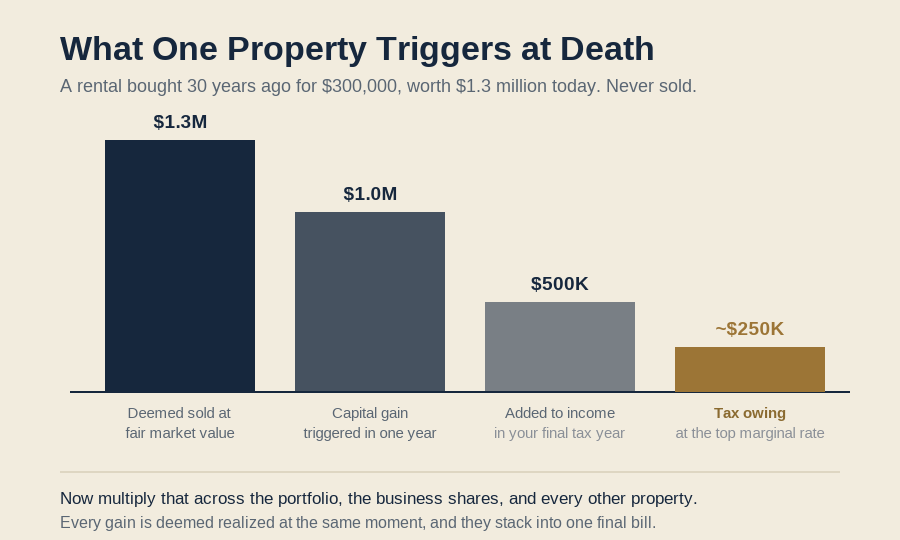
And that's one property. Multiply it across your investment portfolio, your business shares, and any other real estate.
Every asset with accumulated gains gets deemed sold at the same moment, and all those gains stack on top of each other into one final enormous tax bill.
There are a couple of important exemptions. Assets passing to a surviving spouse can generally roll over on a tax-deferred basis, so the bill is postponed until the second spouse passes away. That covers things like your primary residence, or your RRSP if it's set up for a rollover. But for business owners with a corporate holding, secondary rental properties, or large non-registered portfolios, the deemed disposition can be enormous.
Your RRSP deserves its own mention. If there's no surviving spouse to roll it to, the entire balance of your RRSP or RRIF gets added to your income in the year of death. The whole thing, taxed as income, often at the highest rate. For someone with a million dollars in a registered account, that can mean nearly half a million dollars in tax on the RRSP alone.
This is the tax bill nobody talks about. It's real, it's automatic, and for successful people, it's big.
The Gaps That Make It Worse
The deemed disposition is the core problem. What turns a manageable situation into genuine chaos for the family is a collection of planning gaps that tend to sit alongside it. The same ones appear over and over.

Each one is solvable in advance, and each becomes significantly harder to solve once it's too late.
No will, or an outdated will.
You'd be surprised how many business owners don't have a will that's been looked at in the last five years. Some have none at all. Many have one drafted years ago that no longer reflects their actual situation, sometimes still naming an ex-spouse they haven't spoken to. When there's no will, your province decides how your assets are distributed according to a formula that has nothing to do with your wishes. It's called dying intestate, and the process is slower, more expensive, and more stressful for everyone. An outdated will can be almost as bad. One written before you incorporated, before you bought the rental property, while your kids were still at home, or when you were with a different spouse creates confusion, conflict, unintended outcomes, and legal expense. It may reference assets you no longer own or distribute things in ways you wouldn't choose today.
No thought given to executor liability.
Almost nobody knows about this one. The executor of your estate, usually a spouse, an adult child, or a sibling, is personally responsible for making sure the estate taxes get paid. If the executor distributes assets to beneficiaries before settling the bill with the CRA, they can be held personally liable for the unpaid tax, out of their own money. Most people naming an executor have no idea they're handing that person a serious legal and financial responsibility, and most executors have no idea what they signed up for until they're in the middle of it.
No trust structure where one would help.
For families with significant wealth, minor children, a blended family situation, a disabled child, or complicated assets, a trust can provide control, protection, and tax efficiency. But setting one up requires planning while you're alive and have capacity. It generally can't be done after. Without the right structure, wealth can pass in ways that create unnecessary tax, expose assets to creditors or divorce claims, or hand large sums to heirs who aren't equipped to manage them. We've seen situations involving gambling, spending problems, and addiction, where parents were clear they didn't want a lump sum going out that door. Trust planning with scheduled payouts solves exactly that.
No plan for where the money to pay the tax actually comes from.
This is the gap that does the most damage, and it deserves its own section.
Why Cash Liquidity Is the Whole Game
You can have a perfect will, a well-structured estate, and your intentions written out flawlessly, and still create an enormous problem if there's no liquid cash to pay the bill. The deemed disposition tax is due whether the estate has cash or not.
Everything else in estate planning, the will, the trusts, the structure, determines who gets what and how cleanly it transfers. None of it matters if there's no cash to pay the tax that triggers when you pass away.
Picture an estate worth $5 million: a successful business, a couple of properties, an investment portfolio. On paper, the family is inheriting real wealth. The deemed disposition triggers a tax bill of, say, $800,000, due next April. Now look at the liquid cash. Maybe there's $100,000 of actual cash. The other $4.95 million is locked up in the business, the real estate, and the investments.
The family owes $800,000 and has $100,000. They need to find $700,000 quickly.

Where does it come from? Almost certainly from selling something.
Maybe the rental property, except the market might be soft and rentals are sitting. Maybe the investment portfolio, except it might be a down year and this might be a terrible time to liquidate. Maybe part of the business, or the whole business, which they may have wanted to keep in the family.
Whatever they sell, they're selling under time pressure, at whatever price they can get, at a moment chosen by a tax deadline rather than by good judgment. This is how families lose real money even when the estate is large. Not through a bad investment, but through forced liquidation to fund taxes nobody pre-funded.
Here's the key insight. The solution isn't more wealth. This family had $5 million. They had plenty of wealth. The solution is having the right kind of wealth available at the right moment: liquid capital sitting ready, specifically earmarked to pay the tax bill when it comes due.
When that liquidity is in place, everything changes. The tax gets paid and it isn't a big deal. Nothing gets sold under pressure. You can still sell if you want to, but on your terms, not because the CRA needs its money now. The business can stay in the family. The properties can stay in the family. The portfolio can ride out whatever the market is doing. Your family inherits what you actually intended them to inherit.
The difference between those two outcomes isn't the size of the estate. It's whether someone planned for there to be cash at the moment it was needed.
How Life Insurance and the CDA Defuse the Bomb
So how do you create that liquidity? If you're an incorporated business owner, the most powerful answer combines two things, and this is where estate planning gets genuinely elegant.
Start with the insurance. Life insurance is the one financial tool designed to deliver a specific, predetermined amount of cash at exactly the moment of death. That timing isn't a coincidence, it's the entire point of how life insurance works. You can't predict the day you'll die, but you can know in advance that a tax bill is coming. So you put a policy in place and size it to cover what that future bill is likely to be. When you pass away, the death benefit pays out, usually within a couple of weeks, and the cash is there when the estate needs it. Nobody sells anything. Nobody times the market. The liquidity is there by design.
This is why, for the right person, insurance isn't really about protection in the traditional sense. It's about generating cash liquidity when you need it. It's the mechanism that funds the tax bill so your family doesn't have to.
Now layer in the Capital Dividend Account. This is where corporate ownership of the policy makes the strategy dramatically more efficient. When a corporation, usually your holding company, owns the policy and the death benefit pays out, the benefit minus the policy's adjusted cost base gets credited to the corporation's CDA. The CDA is the mechanism that lets a corporation pay money out to shareholders tax-free. Not tax-deferred. Tax-free.

The insurance provides the liquidity. The CDA provides a tax-free route from the company into your family's hands.
Put the sequence together and here's what you've built. The corporation owns the policy. You pass away. The death benefit pays to the corporation and creates the CDA credit. That credit lets the corporation distribute the money tax-free to your family. Your family uses it to pay your final tax bill. The bill is settled. The real estate, the business, and the portfolio stay in the family. Nothing gets sold under pressure, and a significant portion of that capital moves to the next generation without any further tax.
Together, those two pieces turn what would have been a forced-sale crisis into a clean, orderly transition of wealth. That's the difference between an estate plan that survives contact with reality and one that falls apart because it was only ever written on paper, with no plan for the money to actually be there.
If you're a business owner with significant retained earnings inside the corporation, that itself creates a large deemed disposition when you pass away, which makes this one of the most important things you can be thinking about.
Why This Is a Structure Problem, Not a Someday Problem
The psychology is a big part of why this doesn't get dealt with. Estate planning feels like a someday problem. It's about death, which most people don't want to discuss. It's about a future that may be distant, and there's no deadline. Nothing forces the issue. There's no annual reminder and no crisis. So it stays on the list and keeps getting bumped, year after year, while more immediate things take priority. That's understandable.
But it isn't a someday problem. It's a structure problem, and structure problems have to be solved while you still have time and options.
Every strategy that defuses this depends on being set up in advance. The insurance policy needs to exist, and ideally to have been growing for years before it's needed. The corporate structure needs to be properly organized. The will needs to be current. Trusts, where they make sense, take time to establish. None of it can be done at the last minute. By the time the tax bill comes due, the window for most of this planning has closed.
There's another dimension with insurance specifically, and it's invisible until it isn't: it depends on your health. The time to put insurance in place is while you're healthy enough to qualify. If a heart attack or a serious diagnosis is what finally gets you thinking about mortality, you may find the coverage is now significantly more expensive, or that you can't get it at all. That last one is the real problem.

Someone put it to us years ago: buying insurance is like buying a parachute. When the plane is going up, everybody is selling them. When it's going down, nobody is.
The options available to you at 50 may be gone at 65. Coverage that was cheap and easy to get in your forties and fifties can become expensive or impossible after a diagnosis.
The people who handle this well aren't the ones who care more about their families. Everyone cares about their family. They're the ones who understood that legacy planning is structural, and that the structure has to be built before you need it, while it's still possible.
Final Thoughts
If you've built real wealth, the biggest threat to it isn't a market crash. It's this tax bill waiting at the end of your life, triggered automatically, due on a hard deadline, landing on your family at the worst possible moment. You can have an excellent portfolio and still leave your family a crisis if the estate plan underneath it is weak.
But this is a solvable problem. The deemed disposition is predictable. We know it's going to happen. We just don't know exactly when, or precisely how big. And the bill can be estimated: if you hold that rental property for another decade, we can model roughly what it will be worth and what the tax on it will look like.
With the right corporate structure, the right personal structure, insurance set up in the right place to create the liquidity, whether that's personally, in a trust, or in a corporation where it creates CDA credits, and an executor who understands what they're taking on, you can defuse the whole thing before it ever reaches your family. You can even tell them in advance that it's coming and show them how it's handled.
The result is the legacy you actually intended. The business stays in the family. The properties stay in the family. The portfolio stays in the family. Nothing has to be sold under pressure, and the wealth you spent your life building passes to the people you love intact, without causing a commotion.
The first step is simply understanding the number. What would the tax bill actually be if something happened to you now, or in ten years, or in thirty, and where would the money come from to pay it? Most people have never calculated it. Once you see it, the path forward is usually obvious.
If you want to work that out for your situation, book here to schedule a Discovery Call with one of our advisors. We'll talk through your current situation, your goals, and your concerns, estimate your deemed disposition, and show you how to build the structure now, coordinated with your accountant, your lawyer, and your will. No pressure, just clarity on something that matters enormously and that most people never look at directly. If you'd prefer to keep learning first, join our newsletter where we regularly break down advanced planning strategies for Canadian business owners and high-income professionals. You can also follow our YouTube here to keep up on new videos.
Key Takeaways
- Canada has no estate tax, but the deemed disposition does the same work. On death the CRA treats you as having sold every capital asset at fair market value, and every unrealized gain from your lifetime becomes taxable in a single year.
- One property can generate $250,000 of tax. A rental bought for $300,000 and worth $1.3 million produces a $1 million gain, $500,000 added to income, and roughly a quarter million in tax. Then everything else you own stacks on top.
- An RRSP with no surviving spouse to roll to is fully taxable in the year of death. On a $1 million registered account, that can approach half a million dollars in tax on its own.
- The liquidity gap is what does the real damage. A $5 million estate owing $800,000 with $100,000 in cash means someone sells under pressure, at a moment chosen by a tax deadline rather than good judgment. The solution isn't more wealth, it's liquid wealth at the right moment.
- Corporately owned insurance plus the CDA is the cleanest fix, and it has to be built early. The death benefit pays to the corporation, credits the Capital Dividend Account, and flows to your family tax-free, but the policy must be in place while you're still healthy enough to qualify.
Ask AI how Safe Pacific helps business owners and professionals



Book Your Consultation
Book a meeting with Safe Pacific today to design a strategy that fits your goals.
The Tax Bill Waiting at the End of Your Life, and How to Defuse It
Executive Summary Canada has no estate tax, but it has a deemed disposition, which treats you as having sold every capital asset at fair market...
Your Plan Is Only as Good as the Numbers Behind It
Executive Summary A financial plan built on estimates can look perfectly reasonable and still point you in the wrong direction, because small errors in ownership,...
Infinite Banking: The Truth Behind the Hype
Executive Summary The mechanics of infinite banking are completely real, borrowing against the cash value of a participating whole life policy is a legitimate strategy...
The Trapped-Cash Problem
Executive Summary Surplus profit sitting in a corporate bank or investment account is quietly taxed twice, once on the investment income at close to 50%...

Right-Sizing: Why the Best Strategy Isn't Always the Biggest or the Smallest One
Executive Summary The right strategy is the one correctly sized to what you're actually trying to accomplish, which sometimes means less than what's on the...

The Corporate Asset Your Accountant Isn't Talking About
Executive Summary A properly structured corporate-owned participating whole life policy functions less like insurance and more like a tax-sheltered fixed-income allocation on your corporate balance...

If Something Happened to You Tomorrow… Would Your Plan Actually Work?
Executive Summary: Probably not the way you think, because most business owners have the components of a plan rather than a plan designed to function...
You’re Not Paying Too Much Tax — You Just Don’t Have a Strategy
Executive Summary The tax bill that frustrates incorporated Canadians usually isn't caused by the rates, it's caused by the absence of a coordinated strategy across...

The Silent Risk in Your Portfolio
Executive Summary The silent risk is real estate concentration, where 60% to 80% of a successful Canadian's net worth sits in property that can't be...
Why High Income Isn't the Same as Financial Security
Executive Summary A high income is a resource, not a financial plan, and on its own it can hide real structural fragility behind lifestyle creep,...

Your Corporation Has Accounts You've Probably Never Seen
Executive Summary Your corporation tracks three notional accounts, the Capital Dividend Account, RDTOH, and GRIP, that never appear on a statement but directly determine how...
What Happens After You Reach Out to Safe Pacific?
Executive Summary When you reach out to Safe Pacific, a real person from our team emails you within 24 hours with a link to book...


